John 12:26
“‘If anyone serves me, let him follow Me, and where I am, there My servant will be also. If anyone serves Me, him My Father will honor.'”
~~~~~~~~~~
Scripture is from the Holy Bible — New King James Version (NKJV)
Notes on Scripture (below) by tkbrown
~~~~~~~~~~
Lesson Scripture — Matthew 9:1-38
- 1 — “So He got into a boat, crossed over, and came to His own city.”
- 2 — “Then behold, they brought to Him a paralytic lying on a bed. When Jesus saw their faith, He said to the paralytic, ‘Son be of good cheer; your sins are forgiven you.'”
- 3 — “And at once some of the scribes said within themselves, ‘This Man blasphemes!'”
- 4 — “But Jesus, knowing their thoughts, said, ‘Why do you think evil in your hearts?‘”
- 5 — “‘For which is easier, to say, ‘Your sins are forgiven you,’ or to say, ‘Arise and walk?””
- 6 — “‘But that you may know that the Son of Man has power on earth to forgive sins‘–then He said to the paralytic, ‘Arise, take up your bed, and go to your house.'”
- 7 — “And he arose and departed to his house.”
- 8 — “Now when the multitudes saw it, they marveled and glorified God, who had given such power to men.”
- 9 — “As Jesus passed on from there, He saw a man named Matthew sitting at the tax office. And He said to him, ‘Follow Me.‘ So, he arose and followed Him.”
- 10 — “Now it happened, as Jesus sat at the table in the house, that behold, many tax collectors and sinners came and sat down with Him and His disciples.”
- 11 — “And when the Pharisees saw it, they said to His disciples, ‘Why does your Teacher eat with tax collectors and sinners?'”
- 12 — “When Jesus heard that, He said to them, ‘Those who are well have no need of a physician, but those who are sick.'”
- 13 — “‘But go and learn what this means: ‘I desire mercy and not sacrifice.’ For I did not come to call the righteous, but sinners, to repentance.'”
- 14 — “Then the disciples of John came to Him, saying, ‘Why do we and the Pharisees fast often, but Your disciples do not fast?'”
- 15 — “And Jesus said to them, ‘Can the friends of the bridegroom mourn as long as the bridegroom is with them? But the days will come when the bridegroom will be taken away from them, and then they will fast.'”
- 16 — “‘No one puts a piece of unshrunk cloth on an old garment, for the patch pulls away from the garment, and the tear is made worse.'”
- 17 — “‘Nor do they put new wine into old wineskins, or else the wineskins break, the wine is spilled, and the wineskins are ruined. But they put new wine into new wineskins, and both are preserved.'”
- 18 — “While He spoke these things to them, behold, a ruler came and worshiped Him, saying, ‘My daughter has just died, but come and lay Your hand on her and she will live.'”
- 19 — “So, Jesus arose and followed him and so did His disciples.”
- 20 — “And suddenly a woman who had a flow of blood for twelve years came from behind and touched the hem of His garment.”
- 21 — “For she said to herself, ‘If only I may touch His garment, I shall be made well.'”
- 22 — “But Jesus turned around, and when He saw her He said, ‘Be of good cheer, daughter, your faith has made you well.’ And the woman was made well from that hour.”
- 23 — “When Jesus came into the ruler’s house, and saw the flute players and the noisy crowd wailing,”
- 24 — “He said to them, ‘Make room for the girl is not dead, but sleeping.’ And they ridiculed Him.”
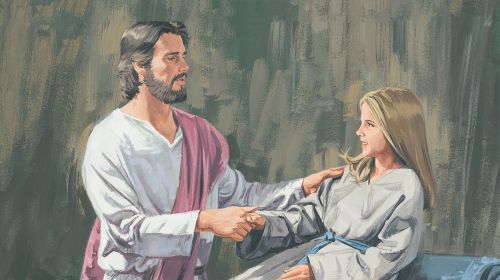
- 25 — “But when the crowd was put outside, He went in and took her by the hand, and the girl arose.”
- 26 — “And the report of this went out into all that land.”
- 27 — “When Jesus departed from there, two blind men followed Him, crying out and saying, ‘Son of David, have mercy on us!'”
- 28 — “And when He had come into the house, the blind men came to Him. And Jesus said to them. ‘Do you believe that I am able to do this?’ They said to Him, ‘Yes, Lord'”
- 29 — “Then He touched their eyes, saying, ‘According to your faith let it be to you.'”
- 30 — “And their eyes were opened. And Jesus sternly warned them, saying, ‘See that no one knows it.'”
- 31 — “But when they had departed, they spread the news about Him in all that country.”
- 32 — “As they went out, behold, they brought to Him a man, mute and demon-possessed.”
- 33 — “And when the demon was cast out, the mute spoke. And the multitudes marveled, saying, ‘It was never seen like this in Israel!'”
- 34 — “But the Pharisees said, ‘He casts out demons by the ruler of the demons.'”
- 35 — “Then Jesus went about all the cities and villages, teaching in their synagogues, preaching the gospel of the kingdom, and healing every sickness and every disease among the people.”
- 36 — “But when He saw the multitudes, He was moved with compassion for them, because they were weary and scattered, like sheep having no shepherd.”
- 37 — “Then He said to His disciples, ‘The harvest truly is plentiful, but the laborers are few.'”
- 38 — “‘Therefore pray the Lord of the harvest to send out laborers into His harvest.”
~~~~~~~~~~
Lesson Scripture — Mark 5:21-43
- 21 — “Now when Jesus had crossed over again by boat to the other side, a great multitude gathered to Him; and He was by the sea.”
- 22 — “And behold, one of the rulers of the synagogue came, Jairus by name. And when he saw Him, he fell at His feet,”
- 23 — and begged Him earnestly, saying, ‘My little daughter lies at the point of death. Come and lay Your hands on her, that she may be healed, and she will live.'”
- 24 — “So Jesus went with him, and a great multitude followed Him and thronged Him.”
- 25 — “Now a certain woman had a flow of blood for twelve years,”
- 26 — “and had suffered many things from many physicians. She had spent all that she had and was no better, but rather grew worse.”
- 27 — “When she heard about Jesus, she came behind Him in the crowd and touched His garment.”
- 28 — “For she said, ‘If only I may touch His clothes, I shall be made well.'”
- 29 — “Immediately the fountain of her blood was dried up, and she felt in her body that she was healed of the affliction.”
- 30 — “And Jesus, immediately knowing in Himself that power had gone out of Him, turned around in the crowd and said, ‘Who touched My clothes?'”
- 31 — “But His disciples said to Him, ‘You see the multitude thronging You, and You say, ‘Who touched Me?'”
- 32 — “And He looked around to see her who had done this thing.”
- 33 — “But the woman, fearing and trembling, knowing what had happened to her, came and fell down before Him and told Him the whole truth.”
- 34 — “And He said to her, ‘Daughter, your faith has made you well. Go in peace and be healed of your affliction.'”
- 35 — “While He was still speaking, some came from the ruler of the synagogue’s house who said, ‘ Your daughter is dead. Why trouble the Teacher any further?'”
- 36 — “As soon as Jesus heard the word that was spoken, He said to the ruler of the synagogue, ‘Do not be afraid, only believe.'”
- 37 — “And He permitted no one to follow Him except Peter, James, and John the brother of James.”
- 38 — “Then He came to the house of the ruler of the synagogue and saw a tumult and those who wept and wailed loudly.”
- 39 — “When He came in, He said to them, ‘Why make this commotion and weep? The child is not dead but sleeping.'”
- 40 — “And they ridiculed Him. But when He had put them all outside, He took the father and the mother of the child, and those who were with Him, and entered where the child was lying.”
- 41 — “Then He took the child by the hand, and said to her, ‘Talitha, cumi,’ which is translated, ‘Little girl, I say to you, arise.'”
- 42 — “Immediately the girl arose and walked, for she was twelve years of age. And they were overcome with great amazement.”
- 43 — “But He commanded them strictly that no one should know it and said that something should be given her to eat.”
~~~~~~~~~~
Lesson Scripture — Luke 5:27-39
- 27 — “After these things He went out and saw a tax collector named Levi, sitting at the tax office. And He said to him, ‘Follow Me.'”
- 28 — “So he left all, rose up, and followed Him.”
- 29 — “Then Levi gave Him a great feast in his own house. And there were a great number of tax collectors and others who sat down with them.”
- 30 — “And their scribes and the Pharisees complained against His disciples, saying, ‘Why do You eat and drink with tax collectors and sinners?”
- 31 — “Jesus answered and said to them, ‘Those who are well have no need of a physician, but those who are sick.'”
- 32 — “I have not come to call the righteous, but sinners, to repentance.'”
- 33 — “Then they said to Him, ‘Why do the disciples of John fast often and make prayers, and likewise those of the Pharisees, but Yours eat and drink?'”
- 34 — “And He said to them, ‘Can you make the friends of the bridegroom fast while the bridegroom is with them?'”
- 35 — “But the days will come when the bridegroom will be taken away from them; then they will fast in those days.'”
- 36 — “Then He spoke a parable to them; ‘No one puts a piece from a new garment on an old one; otherwise the new makes a tear, and also the piece that was taken out of the new does not match the old.'”
- 37 — “And no one puts new wine into old wineskins; or else the new wine will burst the wineskins and be spilled. and the wineskins will be ruined.'”
- 38 — “But new wine must be put into new wineskins, and both are preserved.'”
- 39 — “And no one, having drunk old wine, immediately desires new; for he says, ‘The old is better.'”
~~~~~~~~~~
Lesson Scripture — Luke 8:41-56
- 41 — “And behold, there came a man named Jairus, and he was a ruler of the synagogue. And he fell down at Jesus’ feet and begged Him to come to his house,”
- 42 — “for he had an only daughter about twelve years of age, and she was dying. But as He went, the multitudes thronged Him.”
- 43 — “Now a woman, having a flow of blood for twelve years, who had spent all her livelihood on physicians and could not be healed by any,”
- 44 — “came from behind and touched the border of His garment. And immediately her flow of blood stopped.”
- 45 — “And Jesus said, ‘Who touched Me?’ When all denied it, Peter and those with Him said, ‘Master, the multitudes throng and press You, and You say, ‘Who touched me?'”
- 46 — “But Jesus said, ‘Somebody touched Me, for I perceived power going out from Me.'”
- 47 — “Now when the woman saw that she was not hidden, she came trembling; and falling down before Him, she declared to Him in the presence of all the people the reason she had touched Him and how she was healed immediately.”
- 48 — “And He said to her, ‘Daughter, be of good cheer; your faith has made you well. Go in peace.‘”
- 49 — “While He was still speaking, someone came from the ruler of the synagogue’s house saying to him, ‘Your daughter is dead. Do not trouble the Teacher.'”
- 50 — “But when Jesus heard it, He answered him saying. ‘Do not be afraid; only believe, and she will be made well.'”
- 51 — “When He came into the house, He permitted no one to go in except Peter, James, and John, and the father and mother of the girl.”
- 52 — Now all wept and mourned for her, but He said, ‘Do not weep; she is not dead, but sleeping.'”
- 53 — “And they ridiculed Him, knowing that she was dead.”
- 54 — “But He put them all outside, took her by the hand and called, saying, ‘Little girl, arise.'”
- 55 — Then her spirit returned, and she arose immediately. And He commanded that she be given something to eat.”
- 56 — “And her parents were astonished, but He charged them to tell no one what had happened.”
~~~~~~~~~~
Old Testament Prophecy Related to Matthew 9:1-26
v13 — Hosea 6:6 — “For I desire mercy and not sacrifice, and the knowledge of God more than burnt offerings.”
v23 — 2 Chronicles 35:25 — “Jeremiah also lamented for Josiah. And to this day all the singing men and the singing women speak of Josiah in their lamentations. They made it a custom in Israel; and indeed, they are written in the Laments.”
~~~~~~~~~~
New Testament Scriptures Related to Matthew 9:1-38
v 1 — Matthew 4:13 — “And leaving Nazareth, He came and dwelt in Capernaum, which is by the sea, in the regions of Zebulun and Naphtali,”
v 1 — Matthew 11:23 — “‘And you, Capernaum, who are exalted to heaven, will be brought down to Hades; for if the mighty works which were done to you had been done in Sodom, it would have remained until this day.'”
v 2 — Luke 5:18-26
- 18 – “Then behold, men brought on a bed a man who was paralyzed, who they sought to bring in and lay before Him.”
- 19 – “And when they could not find how they might bring him in, because of the crowd, they went up on the housetop and let him down with his bed through the tiling into the midst before Jesus.”
- 20 – “When He saw their faith, He said to him, ‘Man, your sins are forgiven you.’”
- 21 – “And the scribes and the Pharisees began to reason, saying, ‘Who is this who speaks blasphemies? Who can forgive sins but God alone?’”
- 22 – “But when Jesus perceived their thoughts, He answered and said to them, ‘Why are you reasoning in your hearts?’”
- 23 – “’Which is easier, to say, ‘Your sins are forgiven you,’ or to say, ‘Rise up and walk’?’”
- 24 – “’But that you may know that the Son of Man has power on earth to forgive sins’—He said to the man who was paralyzed, ‘I say to you, arise, take up your bed, and go to your house.’”
- 25 – “Immediately he rose up before them, took up what he had been lying on, and departed to his own house, glorifying God.”
- 26 – “And they were all amazed, and they glorified God and were filled with fear, saying, ‘We have seen strange things today!’”
v 2 — Matthew 8:10 – “When Jesus heard it, He marveled, and said to those who followed, ‘Assuredly, I say to you, I have not found such great faith, not even in Israel!’”
v 4 – Matthew 12:25 – “But Jesus knew their thoughts, and said to them; ‘Every kingdom divided against itself is brought to desolation, and every city or house divided against itself will not stand.’”
v 8 – John 7:15 – “And the Jews marveled, saying, ‘How does this Man know letters, having never studied?’”
v 9 – Luke 5:27 – “After these things He went out and saw a tax collector named Levi, sitting at the tax office. And He said to him, ‘Follow Me.’”
v10 – Mark 2:15 – “Now it happened, as He was dining in Levi’s house, that many tax collectors and sinners also sat together with Jesus and His disciples; for there wre many, and they followed Him.”
v11 – Matthew 11:19 – “’The Son of Man came eating and drinking, and they say, ‘Look, a glutton and a winebibber, a friend of tax collectors and sinners! But wisdom is justified by her children.’”
v11 – Galatians 2:15 – “We who are Jews by nature, and not sinners of the Gentiles,”
v13 – 1 Timothy 1:15 – “This is a faithful saying and worthy of all acceptance, that Christ Jesus might show all longsuffering, as a pattern to those who are going to believe on Him for everlasting life.”
v14 – Luke 5:33-35
- 33 – “Then they said to Him, ‘Why do the disciples of John fast often and make prayers, and likewise those of the Pharisees, but Yours eat and drink?’”
- 34 – “And He said to them, ‘Can you make the friends of the bridegroom fast while the bridegroom is with them?’”
- 35 – “’But the days will come when the bridegroom will be taken away from them; then they will fast in those days.’”
v14 – Luke 18:12 – “’I fast twice a week; I give tithes of all that I possess.’”
v15 – John 3:29 – “He who has the bride is the bridegroom; but the friend of the bridegroom, who stands and hears him, rejoices greatly because of the bridegroom’s voice. Therefore this joy of mine is fulfilled.”
v15 – Acts 13:2, 3
- 2 – “As they ministered to the Lord and fasted, the Holy Spirit said, ‘Now separate to Me Barnabas and Saul for the work to which I have called them.’”
- 3 – “Then, having fasted and prayed, and laid hands on them, they sent them away.”
v15 – Acts 14:23 – “So when they had appointed elders in every church, and prayed with fasting, they commended them to the Lord in whom they had believed.”
v18 – Luke 8:41-56
- 41 – “And behold, there came a man named Jairus, and he was a ruler of the synagogue. And he fell down at Jesus’ feet and begged Him to come to his house,”
- 42 – “for he had an only daughter about twelve years of age, and she was dying. But as He went, the multitudes thronged Him.”
- 43 – “Now a woman, having a flow of blood for twelve years, who had spent all her livelihood on physicians and could not be healed by any,”
- 44 – “came from behind and touched the border of His garment. And immediately her flow of blood stopped.”
- 45 – “And Jesus said, ‘Who touched Me?’ When all denied it, Peter and those with him said, ‘Master, the multitudes throng and press You, and You say, ‘Who touched Me?’’”
- 46 – “But Jesus said, ‘Somebody touched Me, for I perceived power going out from Me.’”
- 47 – “Now when the woman saw that she was not hidden, she came trembling, and falling down before Him, she declared to Him in the presence of all the people the reason she had touched Him and how she was healed immediately.”
- 48 – “And He said to her, ‘Daughter, be of good cheer: your faith has made you well. Go in peace.’”
- 49 – “While He was still speaking, someone came from the ruler of the synagogue’s house, saying to him, ‘Your daughter is dead. Do not trouble the Teacher.’”
- 50 – “But when Jesus heard it, He answered him, saying, ‘Do not be afraid; only believe, and she will be made well.’”
- 51 – “When He came into the house, He permitted no one to go in except Peter, James, and John, and the father and mother of the girl.”
- 52 – “Now all wept and mourned for her, but He said, ‘Do not weep; she is not dead, but sleeping.’”
- 53 – “And they ridiculed Him, knowing that she was dead.”
- 54 – “But He put them all outside, took her by the hand and called, saying, ‘Little girl, arise.’”
- 55 – “Then her spirit returned, and she arose immediately. And He commanded that she be given something to eat.”
- 56 – And her parents were astonished, but He charged them to tell no one what had happened.”
v19 – Matthew 10:2-4
- 2 – “Now the names of the twelve apostles are these: first, Simon, who is called Peter, and Andrew his brother; James the son of Zebedee, and John his brother;”
- 3 – “Philip and Bartholomew; Thomas and Matthew the tax collector; James the son of Alphaeus, and Lebbaeus, whose surname was Thaddaeus;”
- 4 – “Simon the Cananite, and Judas Iscariot, who also betrayed Him.”
v20 – Luke 8:43 – “Now a woman, having a flow of blood for twelve years, who had spent all her livelihood on physicians and could not be healed by any,”
v20 – Matthew 14:36 – “and begged Him that they might only touch the hem of His garment. And as many as t ouched it were made perfectly well.”
v20 – Matthew 23:5 – “’But all their works they do to be seen by men. They make their phylacteries broad and enlarge the borders of their garments.’”
v22 – Luke 7:50 – “Then He said to the woman, ‘Your faith has saved you. Go in peace.’”
v22 – Luke 8:48 – “And He said to her, ‘Daughter, be of good cheer; your faith has made you well. Go in peace.’”
v22 – Luke 17:19 – “So Jesus answered and said, ‘Were there not ten cleansed? But where are the nine?’”
v22 – Luke 18:42 – “Then Jesus said to him, ‘Receive your sight; your faith has made you well.’”
v23 – Mark 5:38 – “Then He came to the house of the ruler of the synagogue and saw a tumult and those who wept and wailed loudly.”
v24 – Acts 20:10 – “But Paul went down, fell on him, and embracing him said, ‘Do not trouble yourselves, for his life is in him.’”
v25 – Mark 1:31 – “So He came and took her by the hand and lifted her up, and immediately the fever left her. And she served them.”
v26 – Matthew 4:24 – “Then His fame went throughout all Syria; and they brought to Him all sick people who were afflicted with various diseases and torments, and those who were demon-possessed, epileptics, and paralytics; and He healed them.”
v27 – Matthew 20:29-34
- 29 – “Now as they weren’t out of Jericho, a great multitude followed Him.”
- 30 – “And behold, two blind men sitting by the road, when they heard that Jesus was passing by, cried out, saying, ‘Have mercy on us, O Lord, Son of David!’”
- 31 – “Then the multitude warned them that they should be quiet; but they cried out all the more, saying, ‘Have mercy on us, O Lord, Son of David!’”
- 32 – “So Jesus stood still and called them, and said, ‘What do you want me to do for you?’”
- 33 – “They said to Him, ‘Lord, that our eyes may be opened.’”
- 34 – “So Jesus had compassion and touched their eyes. And immediately their eyes received sight, and they followed Him.”
v27 – Luke 18:38, 39
- 38 – “And he cried out, saying, ‘Jesus, Son of David, have mercy on me!’”
- 39 – “Then those who went before warned him that he should be quiet; but he cried out all the more, ‘Son of David, have mercy on me!’”
v30 – Matthew 8:4 – “And Jesus said to him, ‘See that you tell no one; but go your way, show yourself to the priest, and offer the gift that Moses commanded, as a testimony to them.’”
v31 – Mark 7:36 – “Then He commanded them that they should tell no one; but the more He commanded them, the more widely they proclaimed it.”
v32 – Matthew 12:22-24
- 22 – “Then one was brought to Him who was demon-possessed, blind and mute; and He healed him, so that the blind and mute man both spoke and saw.”
- 23 – “And all the multitudes were amazed and said, ‘Could this be the Son of David?’”
- 24 – “Now when the Pharisees heard it they said, ‘This fellow does not cast out demons except by Beelzebub, the ruler of the demons.’”
v34 – Luke 11:15 – “But some of them said, ‘He casts out demons by Beelzebub, the ruler of the demons.’”
v35 – Matthew 4:23 – “And Jesus went about all Galilee, teaching in their synagogues, preaching the gospel of the kingdom, and healing all kinds of sickness and all kinds of disease among the people.”
v36 – Mark 6:34 – “And Jesus, when He came out, saw a great multitude and was moved with compassion for them, because they were like sheep not having a shepherd. So He began to teach them many things.”
v37 – Luke 10:2 – “Then He said to them, ‘The harvest truly is great, but the laborers are few; therefore, pray the Lord of the harvest to send out laborers into His harvest.”
v38 – 2 Thessalonians 3:1 – “Finally, brethren, pray for us, that the word of the Lord may run swiftly and be glorified, just as it is with you,”
~~~~~~~~~~
Old Testament Prophecy Related to Mark 5:21-43
v25 — Leviticus 15:19 – “If a woman has a discharge, and the discharge from her body is blood, she shall be set apart seven days; and whoever touches her shall be unclean until evening.”
v25 — Leviticus 15:25 – “If a woman has a discharge of blood for many days, other than at the time of her customary impurity, or if it runs beyond her usual time of impurity, all the days of her unclean discharge shall be as the days of her customary impurity. She shall be unclean.”
v33 – Psalms 89:7 – “God is greatly to be feared in the assembly of the saints. And to be held in reverence by all those around Him.”
~~~~~~~~~~
New Testament Scripture Related to Mark 5:21-43
v21 – Luke 8:40 – “So it was, when Jesus returned that the multitude welcomed Him, for they were all waiting for Him.”
v22 – Matthew 9:18-26
- 18 – “While He spoke these things to them, behold, a ruler came and worshiped Him, saying, ‘My daughter has just died, but come and lay Your hand on her and she will live.’”
- 19 – “So Jesus arose and followed him, and so did His disciples.”
- 20 – “And suddenly, a woman who had a flow of blood for twelve years came from behind and touched the hem of His garment.”
- 21 – “For she said to herself, ‘If only I may touch His garment, I shall be made well.’”
- 22 – “But Jesus turned around, and when He saw her He said, ‘Be of good cheer, daughter; your faith has made you well.’” And the woman was made well from that hour.”
- 23 – “When Jesus came into the ruler’s house, and saw the flute players and the noisy crowd wailing,”
- 24 – “He said to them, ‘Make room, for the girl is not dead, but sleeping.’ And they ridiculed Him.”
- 25 – “But when the crowd was put outside, He went in and took her by the hand, and the girl arose.”
- 26 – “And the report of this went out into all that land.”
v23 – Acts 9:17 – “And Ananias went his way and entered the house; and laying his hands on him he said, ‘Brother Saul, the Lord Jesus, who appeared to you on the road as you came, has sent me that you may receive your sight and be filled with the Holy Spirit.’”
v23 – Acts 28:8 – “And it happened that the father of Publius lay sick of a fever and dysentery, Paul went in to him and prayed, and he laid his hands on him and healed him.”
v27 – Matthew 14:35, 36
- 35 – “And when the men of that place recognized Him, they went out into all that surrounding region, brought to Him all who were sick.”
- 36 – “and begged Him that they might only touch the hem of His garment. And as many as touched it were made perfectly well.”
v30 – Luke 6:19 – “And the whole multitude sought to touch Him, for power went out from Him and healed them all.”
v30 – Luke 8:46 – “But Jesus said, ‘Somebody touched Me, for I perceived power going out from Me.’”
v34 – Matthew 9:22 – “But Jesus turned around, and when He saw her He said, ‘Be of good cheer, daughter; your faith has made you well.’ And the woman was made well from that hour.”
v34 – Luke 7:50 – “Then He said to the woman, ‘Your faith has saved you. Go in peace.’”
v34 – Luke 8:48 – “And He said to her, ‘Daughter, be of good cheer; your faith has made you well. Go in peace.’”
v35 – Luke 8:49 – “While He was still speaking, someone came from the ruler of the synagogue’s house, saying to him, ‘Your daughter is dead. Do not trouble the Teacher.’”
v36 – John 11:40 – “Jesus said to her, ‘Did I not say to you that if you would believe you would see the glory of God?’”
v38 – Acts 9:39 – “Then Peter arose and went with them. When he had come, they brought him to the upper room. And all the widows stood by him weeping, showing the tunics and garments which Dorcas had made while she was with them.”
v39 – John 11:4 – “When Jesus heard that, He said, ‘This sickness is not unto death, but for the glory of God, that the Son of God may be glorified through it.’”
v39 – John 11:11 – “These things He said, and after that He said to them, ‘Our friend Lazarus sleeps, but I go that I may wake him up.’”
v40 – Acts 9:40 – “But Peter put them all out, and knelt down and prayed. And turning to the body he said, ‘Tabitha arise.’ And she opened her eyes, and when she saw Peter she sat up.”
v42 – Mark 1:27 – “Then they were all amazed, so that they questioned among themselves, saying, ‘What is this? What new doctrine is this? For with authority He commands even the unclean spirits, and they obey Him.’”
v42 – Mark 7:37 – “And they were astonished beyond measure, saying, ‘He has done all things well. He makes both the deaf to hear and the mute to speak.’”
v43 – Matthew 8:4 – “And Jesus said to him, ‘See that you tell no one; but go your way, show yourself to the priest, and offer the gift that Moses commanded, as a testimony to them.’”
v43 – Matthew 12:16-21
- 16 – “Yet he warned them not to make Him known,”
- 17 – “that it might be fulfilled which was spoken by Isaiah the prophet, saying:”
- 18 – “’Behold! My Servant whom I have chosen, My Beloved in whom My soul is well pleased! I will put My Spirit upon Him, and He will declare justice to the Gentiles.’”
- 19 – “’He will not quarrel nor cry out. Nor will anyone hear His voice in the streets.’”
- 20 – “’A bruised reed He will not break, and smoking flax He will not quench. Till He sends forth justice to victory;’”
- 21 – “’And in His name Gentiles will trust.’”
v43 – Matthew 17:9 – “Now as they came down from the mountain, Jesus commanded them, saying, ‘Tell the vision to no one until the Son of Man is risen from the dead.’”
~~~~~~~~~~
New Testament Scripture Related to — Luke 5:27-39
v27 – Matthew 9:9-17
- 9 – “As Jesus passed on from there, He saw a man named Matthew sitting at the tax office. And He said to him, ‘Follow Me.’ So, he arose and followed Him.”
- 10 – “Now it happened, as Jesus sat at the table in the house, that behold, many tax collectors and sinners came and sat down with Him and His disciples.”
- 11 – “And when the Pharisees saw it, they said to His disciples, ‘Why does your Teacher eat with tax collectors and sinners?’”
- 12 – “When Jesus heard that, He said to them, ‘Those who are well have no need of a physician, but those who are sick.’”
- 13 – “’But go and learn what this means. ‘I desire mercy and not sacrifice.’ For I did not come to call the righteous, but sinners, to repentance.’”
- 14 – “Then the disciples of John came to Him, saying, ‘Why do we and the Pharisees fast often, but Your disciples do not fast?’”
- 15 – “And Jesus said to them, ‘Can the friends of the bridegroom mourn as long as the bridegroom is with them? But the days will come when the bridegroom will be taken away from them, and then they will fast.’”
- 16 – “’No one puts a piece of unshrunk cloth on an old garment, for the patch pulls away from the garment, and the tear is made worse.’”
- 17 – “Nor do they put new wine into old wineskins, or else the wineskins break, the wine is spilled, and the wineskins are ruined. But they put new wine into new wineskins, and both are preserved.’”
v27 – John 12:26-28
- 26 – “’If anyone serves Me, let him follow Me; and where I am, there My servant will be also. If anyone serves Me, him My Father will honor.’”
- 27 – “’Now My soul is troubled, and what shall I say? ‘Father, save Me from this hour’? But for this purpose, I came to this hour.’”
- 28 – “’Father, glorify Your name.’ Then a voice came from heaven saying, ‘I have both glorified it and will glorify it again.’”
v27 – John 21:19 – “This He spoke, signifying by what death He would glorify God. And when He had spoken this, He said to him, ‘Follow Me.’”
v27 – John 21:22 – “Then this saying went out among the brethren that this disciple would not die. Yet Jesus did not say to him that he would not die, but ‘If I will that he remain till I come, what is that to you?’”
v28 – Mark 10:28 – “Then Peter began to say to Him, ‘See, we have left all and followed You.’”
v29 – Matthew 9:9, 10
- 9 – “As Jesus passed on from there, He saw a man named Matthew sitting at the tax office. And He said to him, ‘Follow Me.’ So, he arose and followed Him.”
- 10 – “Now it happened, as Jesus sat at the table in the house, that behold, many tax collectors and sinners came and sat down with Him and His disciples.”
v29 – Luke 15:1 – “Then all the tax collectors and the sinners drew near to Him to hear Him.”
v30 – Luke 15:2 – “And the Pharisees and scribes complained, saying, ‘This Man receives sinners and eats with them.’”
v32 – 1 Timothy 1:15 – “’This is a faithful saying and worthy of all acceptance, that Christ Jesus came into the world to save sinners, of whom I am chief.’”
v33 – Matthew 9:14 – “Then the disciples of John came to Him saying, ‘Why do we and the Pharisees fast often, but Your disciples do not fast?’”
v34 – John 3:29 – “He who has the bride is the bridegroom; but the friend of the bridegroom, who stands and hears him, rejoices greatly because of the bridegroom’s voice. Therefore, this joy of mine is fulfilled.”
v36 – Mark 2:21, 22
- 21 – “’No one sews a piece of unshrunk cloth on an old garment; or else the new piece pulls away from the old, and the tear is made worse.’”
- 22 – “’And no one puts new wine into old wineskins; or else the new wine bursts the wineskins, the wine is spilled, and the wineskins are ruined. But new wine must be put into new wineskins.’”
~~~~~~~~~~
New Testament Scripture Related to — Luke 8:41-56
v41 – Mark 5:22-43
- 22 – “And behold, one of the rulers of the synagogue came, Jairus by name. And when he saw Him, he fell at His feet.”
- 23 – “and begged Him earnestly, saying, ‘My little daughter lies at the point of death. Come and lay Your hands on her, that she may be healed, and she will live.’”
- 24 – “So Jesus went with him, and a great multitude followed Him and thronged Him.”
- 25 – “Now a certain woman had a flow of blood for twelve years,”
- 26 – “and had suffered many things from physicians. She had spent all that she had and was no better, but rather grew worse.”
- 27 – “When she heard about Jesus, she came behind Him in the crowd and touched His garment.”
- 28 – “For she said, ‘If only I may touch His clothes, I shall be made well.’”
- 29 – “Immediately the fountain of her blood was dried up, and she felt in her body that she was healed of the affliction.”
- 30 – “And Jesus, immediately knowing in Himself that power had gone out of Him, turned around in the crowd and said, “Who touched My clothes?”
- 31 – “But His disciples said to Him, ‘You see the multitude thronging You, and You say, ‘Who touched Me?’’”
- 32 – “And He looked around to see her who had done this thing.”
- 33 – “But the woman, fearing and trembling, knowing what had happened to her, came and fell down before Him and told Him the whole truth.”
- 34 – “And He said to her, “Daughter, your faith has made you well. Go in peace and be healed of your affliction.’”
- 35 – “While He was still speaking, some came from the ruler of the synagogue’s house who said, ‘Your daughter is dead. Why trouble the Teacher any further?’”
- 36 – “As soon as Jesus heard the word that was spoken, He said to the ruler of the synagogue, ‘Do not be afraid, only believe.’”
- 37 – “And He permitted no one to follow Him except Peter, James, and John the brother of James.”
- 38 – “Then He came to the house of the ruler of the synagogue and saw a tumult and those who wept and wailed loudly.”
- 39 – “When He came in, He said to them, ‘Why make this commotion and weep? The child is not dead but sleeping.’”
- 40 – “And they ridiculed Him. But when He had put them all outside, He took the father and the mother of the child, and those who were with Him, and entered where the child was lying.”
- 41 – “Then He took the child by the hand, and said to her, ‘Talitha, cumi,’ which is translated, ‘Little girl, I say to you, arise.’”
- 42 – “Immediately the girl arose and walked, for she was twelve years of age. And they were overcome with great amazement.”
- 43 – “But He commanded them strictly that no one should know it and said that something should be given her to eat.”
v42 – Luke 7:2 – “And a certain centurion’s servant, who was dear to him, was sick and ready to die.”
v43 – Matthew 9:20 – “And suddenly, a woman who had a flow of blood for twelve years came from behind and touched the hem of his garment.”
v43 – Luke 15:18-22
- 18 – “’I will arise and go to my father and will say to him, ‘Father, I have sinned against heaven and before you,’”
- 19 – “’and I am no longer worthy to be called your son. Make me like one of your hired servants.’”
- 20 – “’And he arose and came to his father. But when he was still a great way off, his father saw him and had compassion, and ran and fell on his neck and kissed him.’”
- 21 – “’And the son said to him, ‘Father, I have sinned against heaven and in your sight, and am no longer worthy to be called your son.’’”
- 22 – “’But the father said to his servants, ‘Bring out the best robe and put it on him, and put a ring on his hand and sandals on his feet.’”
v44 – Mark 6:56 – “Wherever He entered, into villages, cities, or the country, they laid the sick in the marketplaces, and begged Him that they might just touch the hem of His garment. And as many as touched Him were made well.”
v46 – Mark 5:30 – “And Jesus, immediately knowing in Himself that power had gone out of Him, turned around in the crowd and said, ‘Who touched My clothes?’”
v48 – Luke 7:50 – “Then He said to the woman, ‘Your faith has saved you. Go in peace.’”
v48 – John 8:11 – “She said, ‘No one, Lord.’ And Jesus said to her, ‘Neither do I condemn you; go and sin no more.’”
v49 – Mark 5:35 – “While He was still speaking, some came from the ruler of the synagogue’s house who said, ‘Your daughter is dead. Why trouble the Teacher any further?’”
v50 – Mark 11:22-24
- 22 – “So Jesus answered and said to them, ‘Have faith in God.’”
- 23 – “’For assuredly, I say to you, whoever says to this mountain, ‘Be removed and be cast into the sea,’ and does not doubt in his heart, but believes that those things he says will be done, he will have whatever he says.’”
- 24 – “’Therefore, I say to you, whatever things you ask when you pray, believe that you receive them, and you will have them.’”
v52 – Luke 7:13 – “When the Lord saw her, He had compassion on her and said to her, ‘Do not weep.’”
v52 – John 11:11-13
- 11 – “These things He said, and after that He said to them, ‘Our friend Lazarus sleeps, but I go that I may wake him up.’”
- 12 – “Then His disciples said, ‘Lord, if he sleeps he will get well.’”
- 13 – “However, Jesus spoke of his death, but they thought that He was speaking about taking rest in sleep.”
v54 – John 11:43 – “Now when He had said these things, He cried with a loud voice, ‘Lazarus, come forth!’”
v56 – Matthew 8:4 – “And Jesus said to him, ‘See that you tell no one; but go your way, show yourself to the priest, and offer the gift that Moses commanded, as a testimony to them.’”
v56 – Matthew 9:30 – “And their eyes were opened. And Jesus sternly warned them, saying, ‘See that no one knows it.’”
~~~~~~~~~~
Notes on Scripture: by tkbrown
Jesus selected two tax collectors to be among His twelve disciples: Matthew and Levi (also known as James the son of Alphaeus). He chose both in almost the same way. Whether or not He chose them on the same day is not stated, that I can find. The major difference in His manner of choosing the two was that Levi gave a big feast for Jesus which many tax collectors and others attended.
In Luke 5:27, we see Jesus was walking by the tax office when He saw one of the tax collectors sitting at the office, whose name was Levi. He said to Levi, “Follow Me.” Levi immediately left the tax office, all who were there, and followed Jesus. Then, in Luke 5:29, we are told he gave a big feast for Jesus.
In Matthew 9:9, we see Jesus walking by a tax office and seeing a man named Matthew sitting there. We are not told whether Levi and Matthew were seen sitting in the same tax office but on separate occasions. We are merely given enough information to know the two apostles were called to follow Jesus in much the same manner. It is also not made known whether the meal was in the same house at the same time, or in two separate houses, but we are shown that the Pharisees’ responses were identical. Thus, I am guessing the meal referenced was the one where Levi gave a big feast for Jesus.
When the scribes and Pharisees learned of this, they complained, and said: “Why do you eat and drink with tax collectors and sinners?” Jesus replied, “Those who are well have no need of a physician, but those who are sick. I have not come to call the righteous, but sinners, to repentance.’”
After this the scribes and Pharisees said to Jesus, “Why do the disciples of John fast often and make prayers, and likewise those of the Pharisees, but Yours eat and drink?” To this, Jesus replied, telling them while the friends are with the bridegroom there is no need to fast, but when the bridegroom is ‘taken away’—then they will fast also.
He followed up with a parable in which he reminded them, a new piece of cloth is never put on an old garment to patch it for it would pull loose and make the tear worse. Likewise, new wine is never put into old wineskins, for as the wine expands during fermentation, it would burst the old wineskins and both would be wasted. Thus, new wine is put into new wineskins and both are preserved. He added that no one prefers new wine to old wine, for the old wine is better.
This parable was to explain to the scribes and Pharisees that the Old Covenant (Testament) and the New Covenant (Testament) are not the same. In the Old Testament, God visited specific men to direct them in the manner they were to lead His people – the Israelites. In the New Testament, Jesus came to earth as a Man so He might understand the struggles of man in meeting the requirements Christ set forth for His church. The Old Testament required sacrificial blood be shed for the forgiveness of sins and for various cleansings. These were done on a yearly basis to roll the sins forward a year. In the New Testament, Jesus was the “sacrificial lamb” whose blood was shed to wash away the sins of all who would believe on His name and follow His teachings. The Old Covenant was a sacrificial one. The New Testament is a forgiveness based on mercy because the blood has already been shed.
So, in answer to the Pharisees’ question, Jesus explained: As long as He was with his followers, there would be no need for them to fast. Only when He left would there be a need for his disciples to fast. Thus, the old fabric and the new fabric as well as the old wine and the new wine illustrated the scribes and Pharisees followed one path and would not be well served by expecting Jesus followers to worship in the old way for they now worshiped with Jesus in the new way. He was telling them, you do your fasting as you always have if you so choose. His followers would fast when He was no longer there and they would continue to worship him in the same manner as when he was with them..
Jairus,’ a ruler of the synagogue, had a daughter who was very sick and about to die. He went to Jesus and fell at His feet begging that He come to his house and heal her. When Jesus heard his plight, He went with Jairus to his house.
On the way to Jairus house, Jesus felt power leaving his body, going into someone who touched Him. He turned to the crowed who thronged Him and asked, “Who touched Me?” His disciples apparently were incredulous at this question. Peter said, “Master, see how many people are thronging around and against You—and You ask who touched You?” Jesus replied, “I felt power leaving My body.”
Then a woman stepped forth and admitted she had touched the hem of His garment, believing it could heal her if only she could touch His clothing. Immediately, she had felt the healing; the blood flow from which she had suffered for twelve years had stopped. She had seen many doctors about the problem and had exhausted all resources trying to find a treatment for the ailment which continued to grow worse. Then Jesus told her, “Daughter, your faith has healed you. Go, in peace, and be healed of your affliction.”
About that time, one from the house of Jairus, came and said to him, “Your daughter is dead. Trouble the Teacher no more.” Then Jesus said to Jairus, “Only believe! Your daughter is not dead,” and they continued to his house. Upon arrival, there was a crowd already there lamenting his daughter’s death—weeping and wailing loudly. Jesus said, “Why do you make this commotion? She is not dead but sleeping.” Then the crowd ridiculed Him.
Jesus only allowed Peter, James, and John to accompany Him to Jairus’ house. He took them–Jairus and Jairus’ wife–with Him in to where the girl was lying. Then, when He took her hand and told her to arise, she arose and walked. All were amazed. Jesus instructed them to tell no one of these happenings, but word spread like a wildfire throughout the region.
When Jesus left Jairus’ house, two blind men followed Him calling out to Him, “Son of David, have mercy on us!” Those who were around Jesus tried to quiet them, but they kept crying and calling. Jesus turned to them and asked them what they wanted. They told Him if He would lay his hands upon them, they would be able to see. Jesus asked, “Do you believe that I am able to do this?” To this, they replied, “Yes, Lord!” So, Jesus touched them, and they were able to see. Then He instructed them to tell no one of this event. But, when they left, they told everyone they saw.
Then a demon-possessed man was brought to Jesus. When He cast out the demons, the people marveled at His power. The Pharisees, on the other hand, said He could only cast out demons by the power of the ruler of the demons. This did not stop Jesus from healing the sick and tormented. Everywhere He went, the sick, the maimed, and the tormented were brought to Him, and He had compassion on them—healing everyone—because He saw them as being like sheep with no shepherd to care. He told His disciples the harvest was plentiful but laborers were few, and He instructed them to pray for God to send laborers to reap the harvest for Him.
Every time Jesus healed someone and told them not to tell anyone of the miracle, the region knew of it in rapid form. This seems to be human nature. As sure as we are told not to tell or do something, usually we do just what we have been instructed not to do. I wonder, if Jesus were on earth today healing all who were brought to Him, what would the response of the multitudes be? Would they welcome Him and bring the sick, the maimed, and the tormented for His healing, or would they question and ridicule Him?
As for me, I am thankful Jesus came to earth and died for my sins. Never am I worthy of such love, but I am grateful to my dying day for the grace He has bestowed upon me.
~~~~~~~~~~
- Lesson One: Zacharias to Have Son
- Lesson Two: Jesus Birth Foretold
- Lesson Three: Zacharias’ Son, John, is Born
- Lesson Four: Jesus is Born
- Lesson Five: And Jesus Grew . . .
- Lesson Six: John Begins His Ministry
- Lesson Seven: Jesus is Introduced to the World
- Lesson Eight: Jesus’ Ancestral Lineage
- Lesson Nine: Jesus is Tempted by Satan
- Lesson Ten: Jesus Begins His Ministry (Part 1)
- Lesson Eleven: Jesus Begins His Ministry (Part 2) — Sermon on the Mount (Part 1)
- Lesson Twelve: Jesus Begins His Ministry (Part 3) — Sermon on the Mount (Part 2)
- Lesson Thirteen: Jesus Begins His Ministry (Part 4) — Sermon on the Mount (Part 3)
- Lesson Fourteen: Jesus Begins His Ministry (Part 5) — Sermon on the Mount (Part 4 — Conclusion)
- Lesson Fifteen: Jesus Turns Water to Wine — The Wedding at Cana
- Lesson Sixteen: Jesus Heals the Sick, Casts Out Demons
- Lesson Seventeen: Jesus Talks With Nicodemus
- Lesson Eighteen: Jesus and Jairus’ Daughter
~~~~~~~~~~
~~~~~~~~~~







 by tkbrown
You must be logged in to post a comment.