The Healing Power of Faith

~~ a devotional ~~

~~ by tkbrown — ≥∑

“So Jesus said to them, ‘Because of your unbelief, for assuredly, I say to you, if you have faith as a mustard seed, you will say to this mountain, ‘Move from here to there,’ and it will move and nothing will be impossible for you.'”

Holy Bible (New King James Version)Matthew 17:20

If faith the size of a mustard seed can move a mountain, what can faith do for us in our daily lives? How many times have you said to yourself, “If I could just _____.” Fill in the blank with whatever you may have desired. This is not to say if we ask for a million dollars with an undying faith, we will receive it. We probably won’t, but not because we didn’t have adequate faith.

Perhaps when we do not get the object of our prayers, we ask in the wrong spirit, or we ask for the wrong thing, or maybe we just are not ready for that prayer to be answered. For example, if I ask for something that will lead me astray, I may or may not get it. If I do get it, it will test my resolve to serve God and Jesus. Perhaps God is using my prayer and the object of my desire to refine my faith, making it purer by skimming off the sin associated with that request. The refinement will only occur if I survive the “smelting process,” remaining true to my faith in God throughout or–if I have given in to temptation–returning to that faith at some point in a spirit of repentance.

Sometimes, when we are “too sure of our faith,” we stray because our faith has been placed in ourselves instead of in Jesus Christ and God in heaven above. Sometimes–during this “faith in ourselves”–we fail the refinement process because we have placed our faith in another person or persons rather than in Jesus Christ’s ability to carry us through any storm.

Putting our faith in another follower of Christ–or group of followers– can take the wind from beneath our wings if those brothers and sisters in Christ fail us in a time of true need. It is during such times that we must keep our “eye” on Christ in order to receive His guidance and strength. If I have never truly strayed before, this might be just what is needed for me to realize the depth of my sin and my need for forgiveness. Sometimes, when we are too certain of our faith, we have to fall hard before we can renew that faith by repenting and begging God’s forgiveness.

Then again, there are times when the sin in our lives prior to repentance and the receiving of God’s forgiveness was so great there is no doubt in our mind of our need. Prior to his conversion, Paul (then Saul) of Tarsus had set about destroying the followers of Christ. Truly believing he was doing what God wanted, Paul put everything he had into the effort. Then, he was stricken blind when he met Jesus on the road to Damascus. This gave him a few days to think about his past and what he had been doing.

When Ananias came to him and instructed Paul in what he must do, he repented and was baptized immediately (Acts 9:1-22).

Acts 9:1-22 (NKJV)

  • 1 — “Then Saul, still breathing threats and murder against the disciples of the Lord, went to the high priest”
  • 2 — “and asked letters from him to the synagogues of Damascus, so that if he found any who were of the Way, whether men or women, he might bring them bound to Jerusalem.”
  • 3 — “As he journeyed he came near Damascus, and suddenly a light shone around him from heaven.”
  • 4 — “Then he fell to the ground, and heard a voice saying to him, ‘Saul, Saul, why are you persecuting Me?'”
  • 5 — “And he said, “Who are You, Lord?’ Then the Lord said, ‘I am Jesus, whom you are persecuting. It is hard for you to kick against the goads.'”
  • 6 — “So he, trembling and astonished, said, ‘Lord, what do You want me to do?’ Then the Lord said to him, ‘Arise and go into the city, and you will be told what you must do‘”
  • 7 — “And the men who journeyed with him stood speechless, hearing a voice but seeing no one.”
  • 8 — “Then Saul arose from the ground, and when his eyes were opened he saw no one. But they led him by the hand and brought him into Damascus.”
  • 9 — “And he was three days without sight, and neither ate nor drank.”
  • 10 — “Now there was a certain disciple at Damascus named Ananias, and to him the Lord said in a vision, ‘Ananias.’ And he said, ‘Here I am, Lord.'”
  • 11 — “So the Lord said to him, ‘Arise and go to the street called Straight, and inquire at the house of Judas for one called Saul of Tarsus for behold, he is praying.'”
  • 12 — “‘And in a vision he has seen a man named Ananias coming in and putting his hand on him, so that he might receive his sight.'”
  • 13 — “Then Ananias answered, ‘Lord, I have heard from many about this man, how much harm he has done to Your saints in Jerusalem.'”
  • 14 — “‘And here he has authority from the chief priests to bind all who call on Your name.'”
  • 15 — “But the Lord said to him, ‘Go, for he is a chosen vessel of Mine to bear My name before Gentiles, kings, and the children of Israel.'”
  • 16 — “‘For I will show him how many things he must suffer for My names sake.'”
  • 17 — “And Ananias wen his way and entered the house; and laying his hands on him he said, ‘Brother Saul, the Lord Jesus, who appeared to you on the road as you came, has sent me that you may receive your sight and be filled with the Holy Spirit.'”
  • 18 — “Immediately there fell from his eyes something like scales, and he received his sight at once; and he arose and was baptized.”
  • 19 — “So when he had received food, he was strengthened. Then Saul spent some days with the disciples at Damascus.”
  • 20 — “Immediately he preached the Christ in the synagogues, that He is the Son of God.”
  • 21 — “Then all who heard were amazed, and said, ‘Is this not he who destroyed those who called on this name in Jerusalem, and has come here for that purpose, so that he might bring them bound to the chief priests?'”
  • 22 — “But Saul increased all the more in strength, and confounded the Jews who dwelt in Damascus, proving that this Jesus is the Christ.”

After this time, Paul was even more zealous for Christ’s cause than he had been against it prior to the forgiveness received when he was appointed the replacement apostle for Judas Iscariot. Later, in Chapter One, Verse Fifteen of Paul’s First Letter of instruction to Timothy, he said: “This is a faithful saying and worthy of all acceptance, that Christ Jesus came into the world to save sinners, of whom I am chief.” In this statement, Paul told Timothy he had “seen the light” regarding the ill-founded reasoning of his past and was not ashamed to admit his wrongdoing because his forgiveness proved Jesus purpose for coming to this earth.

The devotional scripture I have chosen today (below) reveals a faith that would move mountains. This woman had suffered female problems for twelve years. She and been to doctor after doctor and had suffered many treatments–some of them apparently quite painful–to no avail. The only thing she had to represent her faith in doctors was destitute poverty.

When this woman heard about Jesus healing the sick, the maimed, and the demon possessed, she knew she would be healed if it were possible to merely touch the garment He wore. She knew she would not need Him to touch her, she would be healed by the power in the garment He wore. Upon learning Jesus was in the area, she pressed through the crowds surrounding Him and . . . finally . . . she managed to touch the hem of His garment. Immediately, she was healed. Immediately the flow of blood stopped!

When Jesus turned and asked, “Who touched Me?” she just knew she was in trouble. She tried to shrink away and hide–then, He looked here in the eye. She knew, He knew it had been her. So, she went forward and fell at His feet. Tearfully she told of her lengthy plight and her faith she would be healed if she could only touch His garment. She needed not disturb Him, she would be healed by the power in His garment.

When Jesus heard her reasoning behind touching His robe, He said “her faith had healed her,” and He told her to “go in peace.” Can you imagine her relief at the understanding of His forgiveness and of the fact that her faith in Him had saved her? What an example for those of us looking for a source of strength in this day and time! We need look no further than the example this woman provides. Whatever our need, whatever our ailment, whatever our weakness, He will heal us if only we believe.

I pray our hearts will always be open to the guidance and strength Jesus provides if only we believe He can and will. I cannot count the times this has been proven in my life, and I am thankful for each. I know I have sinned and come short of God’s glory. I know Jesus forgiveness for that sin and His guidance will pull me through and into heaven at day’s end. It is my prayer that each person reading this devotional can see the same in his or her life. For those who are not quite there yet, I pray somehow the path can be seen and followed before it is too late.

Blessings, and for those in America and those who join us in spirit this week, Happy Thanksgiving! I am thankful for Christ, for His forgiveness, and for His loving guidance when I get out of my own way. For what are you thankful this holiday week? Please feel free to share in the comments below.

Mark 5:25-34 (NKJV)

  • 25 — “Now a certain woman had a flow of blood for twelve years.”
  • 26 — “and had suffered many things from many physicians. She had spent all that she had and was no better, but rather grew worse.”
  • 27 — “When she heard about Jesus, she came behind Him in the crowd and touched His garment.”
  • 28 — “Immediately the fountain of her blood was dried up, and she felt in her body that she was healed of the affliction.”
  • 30 — “And Jesus, immediately knowing in Himself that power had gone out of Him, turned around in the crowd and said, ‘Who touched My clothes?'”
  • 31 — “But His disciples said to Him, ‘You see the multitude thronging You, and You say, ‘Who touched Me?””
  • 32 — “And He looked around to see her who had done this thing.”
  • 33 — “But the woman, fearing and trembling, knowing what had happened to her, came and fell down before Him and told Him the whole truth.”
  • 34 — “And He said to her, ‘Daughter, your faith has made you well. Go in peace and be healed of your affliction.'”

~~~~~~~~~~

Wind Beneath My Wings – lyrics – BETTE MIDLER

~~~~~~~~~

I know this song may not have been written to reflect faith in Jesus Christ, but it perfectly describes my faith in Him. He is “everything I would like to be” and He is “the wind beneath my wings.” Only with His love, support, strength, and guidance will I be able to be true to my quest of serving God. Listen to the song and apply the words to a faith in Jesus Christ. Let me know what you think. Do you think they can describe faith in Jesus Christ?

~~~~~~~~~~

Source: Holy Bible — New King James Version (NKJV)

~~~~~~~~~~

Photo Above: by Brigitte @ Unsplash.com.

~~~~~~~~~~

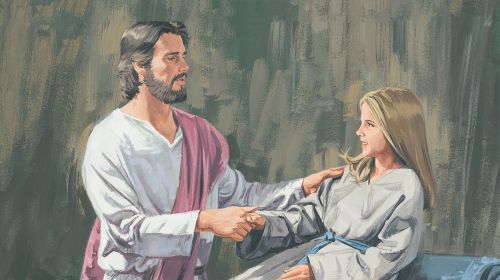
Jesus and Jairus’ Daughter

John 12:26

“‘If anyone serves me, let him follow Me, and where I am, there My servant will be also. If anyone serves Me, him My Father will honor.'”

~~~~~~~~~~

Scripture is from the Holy Bible — New King James Version (NKJV)

Notes on Scripture (below) by tkbrown

~~~~~~~~~~

Lesson Scripture — Matthew 9:1-38

  • 1 — “So He got into a boat, crossed over, and came to His own city.”
  • 2 — “Then behold, they brought to Him a paralytic lying on a bed. When Jesus saw their faith, He said to the paralytic, ‘Son be of good cheer; your sins are forgiven you.'”
  • 3 — “And at once some of the scribes said within themselves, ‘This Man blasphemes!'”
  • 4 — “But Jesus, knowing their thoughts, said, ‘Why do you think evil in your hearts?‘”
  • 5 — “‘For which is easier, to say, ‘Your sins are forgiven you,’ or to say, ‘Arise and walk?””
  • 6 — “‘But that you may know that the Son of Man has power on earth to forgive sins‘–then He said to the paralytic, ‘Arise, take up your bed, and go to your house.'”
  • 7 — “And he arose and departed to his house.”
  • 8 — “Now when the multitudes saw it, they marveled and glorified God, who had given such power to men.”
  • 9 — “As Jesus passed on from there, He saw a man named Matthew sitting at the tax office. And He said to him, ‘Follow Me.‘ So, he arose and followed Him.”
  • 10 — “Now it happened, as Jesus sat at the table in the house, that behold, many tax collectors and sinners came and sat down with Him and His disciples.”
  • 11 — “And when the Pharisees saw it, they said to His disciples, ‘Why does your Teacher eat with tax collectors and sinners?'”
  • 12 — “When Jesus heard that, He said to them, ‘Those who are well have no need of a physician, but those who are sick.'”
  • 13 — “‘But go and learn what this means: ‘I desire mercy and not sacrifice.’ For I did not come to call the righteous, but sinners, to repentance.'”
  • 14 — “Then the disciples of John came to Him, saying, ‘Why do we and the Pharisees fast often, but Your disciples do not fast?'”
  • 15 — “And Jesus said to them, ‘Can the friends of the bridegroom mourn as long as the bridegroom is with them? But the days will come when the bridegroom will be taken away from them, and then they will fast.'”
  • 16 — “‘No one puts a piece of unshrunk cloth on an old garment, for the patch pulls away from the garment, and the tear is made worse.'”
  • 17 — “‘Nor do they put new wine into old wineskins, or else the wineskins break, the wine is spilled, and the wineskins are ruined. But they put new wine into new wineskins, and both are preserved.'”
  • 18 — “While He spoke these things to them, behold, a ruler came and worshiped Him, saying, ‘My daughter has just died, but come and lay Your hand on her and she will live.'”
  • 19 — “So, Jesus arose and followed him and so did His disciples.”
  • 20 — “And suddenly a woman who had a flow of blood for twelve years came from behind and touched the hem of His garment.”
  • 21 — “For she said to herself, ‘If only I may touch His garment, I shall be made well.'”
  • 22 — “But Jesus turned around, and when He saw her He said, ‘Be of good cheer, daughter, your faith has made you well.’ And the woman was made well from that hour.”
  • 23 — “When Jesus came into the ruler’s house, and saw the flute players and the noisy crowd wailing,”
  • 24 — “He said to them, ‘Make room for the girl is not dead, but sleeping.’ And they ridiculed Him.”
  • 25 — “But when the crowd was put outside, He went in and took her by the hand, and the girl arose.”
  • 26 — “And the report of this went out into all that land.”
  • 27 — “When Jesus departed from there, two blind men followed Him, crying out and saying, ‘Son of David, have mercy on us!'”
  • 28 — “And when He had come into the house, the blind men came to Him. And Jesus said to them. ‘Do you believe that I am able to do this?’ They said to Him, ‘Yes, Lord'”
  • 29 — “Then He touched their eyes, saying, ‘According to your faith let it be to you.'”
  • 30 — “And their eyes were opened. And Jesus sternly warned them, saying, ‘See that no one knows it.'”
  • 31 — “But when they had departed, they spread the news about Him in all that country.”
  • 32 — “As they went out, behold, they brought to Him a man, mute and demon-possessed.”
  • 33 — “And when the demon was cast out, the mute spoke. And the multitudes marveled, saying, ‘It was never seen like this in Israel!'”
  • 34 — “But the Pharisees said, ‘He casts out demons by the ruler of the demons.'”
  • 35 — “Then Jesus went about all the cities and villages, teaching in their synagogues, preaching the gospel of the kingdom, and healing every sickness and every disease among the people.”
  • 36 — “But when He saw the multitudes, He was moved with compassion for them, because they were weary and scattered, like sheep having no shepherd.”
  • 37 — “Then He said to His disciples, ‘The harvest truly is plentiful, but the laborers are few.'”
  • 38 — “‘Therefore pray the Lord of the harvest to send out laborers into His harvest.”

~~~~~~~~~~

Lesson Scripture — Mark 5:21-43

  • 21 — “Now when Jesus had crossed over again by boat to the other side, a great multitude gathered to Him; and He was by the sea.”
  • 22 — “And behold, one of the rulers of the synagogue came, Jairus by name. And when he saw Him, he fell at His feet,”
  • 23 — and begged Him earnestly, saying, ‘My little daughter lies at the point of death. Come and lay Your hands on her, that she may be healed, and she will live.'”
  • 24 — “So Jesus went with him, and a great multitude followed Him and thronged Him.”
  • 25 — “Now a certain woman had a flow of blood for twelve years,”
  • 26 — “and had suffered many things from many physicians. She had spent all that she had and was no better, but rather grew worse.”
  • 27 — “When she heard about Jesus, she came behind Him in the crowd and touched His garment.”
  • 28 — “For she said, ‘If only I may touch His clothes, I shall be made well.'”
  • 29 — “Immediately the fountain of her blood was dried up, and she felt in her body that she was healed of the affliction.”
  • 30 — “And Jesus, immediately knowing in Himself that power had gone out of Him, turned around in the crowd and said, ‘Who touched My clothes?'”
  • 31 — “But His disciples said to Him, ‘You see the multitude thronging You, and You say, ‘Who touched Me?'”
  • 32 — “And He looked around to see her who had done this thing.”
  • 33 — “But the woman, fearing and trembling, knowing what had happened to her, came and fell down before Him and told Him the whole truth.”
  • 34 — “And He said to her, ‘Daughter, your faith has made you well. Go in peace and be healed of your affliction.'”
  • 35 — “While He was still speaking, some came from the ruler of the synagogue’s house who said, ‘ Your daughter is dead. Why trouble the Teacher any further?'”
  • 36 — “As soon as Jesus heard the word that was spoken, He said to the ruler of the synagogue, ‘Do not be afraid, only believe.'”
  • 37 — “And He permitted no one to follow Him except Peter, James, and John the brother of James.”
  • 38 — “Then He came to the house of the ruler of the synagogue and saw a tumult and those who wept and wailed loudly.”
  • 39 — “When He came in, He said to them, ‘Why make this commotion and weep? The child is not dead but sleeping.'”
  • 40 — “And they ridiculed Him. But when He had put them all outside, He took the father and the mother of the child, and those who were with Him, and entered where the child was lying.”
  • 41 — “Then He took the child by the hand, and said to her, ‘Talitha, cumi,’ which is translated, ‘Little girl, I say to you, arise.'”
  • 42 — “Immediately the girl arose and walked, for she was twelve years of age. And they were overcome with great amazement.”
  • 43 — “But He commanded them strictly that no one should know it and said that something should be given her to eat.”

~~~~~~~~~~

Lesson Scripture — Luke 5:27-39

  • 27 — “After these things He went out and saw a tax collector named Levi, sitting at the tax office. And He said to him, ‘Follow Me.'”
  • 28 — “So he left all, rose up, and followed Him.”
  • 29 — “Then Levi gave Him a great feast in his own house. And there were a great number of tax collectors and others who sat down with them.”
  • 30 — “And their scribes and the Pharisees complained against His disciples, saying, ‘Why do You eat and drink with tax collectors and sinners?”
  • 31 — “Jesus answered and said to them, ‘Those who are well have no need of a physician, but those who are sick.'”
  • 32 — “I have not come to call the righteous, but sinners, to repentance.'”
  • 33 — “Then they said to Him, ‘Why do the disciples of John fast often and make prayers, and likewise those of the Pharisees, but Yours eat and drink?'”
  • 34 — “And He said to them, ‘Can you make the friends of the bridegroom fast while the bridegroom is with them?'”
  • 35 — “But the days will come when the bridegroom will be taken away from them; then they will fast in those days.'”
  • 36 — “Then He spoke a parable to them; ‘No one puts a piece from a new garment on an old one; otherwise the new makes a tear, and also the piece that was taken out of the new does not match the old.'”
  • 37 — “And no one puts new wine into old wineskins; or else the new wine will burst the wineskins and be spilled. and the wineskins will be ruined.'”
  • 38 — “But new wine must be put into new wineskins, and both are preserved.'”
  • 39 — “And no one, having drunk old wine, immediately desires new; for he says, ‘The old is better.'”

~~~~~~~~~~

Lesson Scripture — Luke 8:41-56

  • 41 — “And behold, there came a man named Jairus, and he was a ruler of the synagogue. And he fell down at Jesus’ feet and begged Him to come to his house,”
  • 42 — “for he had an only daughter about twelve years of age, and she was dying. But as He went, the multitudes thronged Him.”
  • 43 — “Now a woman, having a flow of blood for twelve years, who had spent all her livelihood on physicians and could not be healed by any,”
  • 44 — “came from behind and touched the border of His garment. And immediately her flow of blood stopped.”
  • 45 — “And Jesus said, ‘Who touched Me?’ When all denied it, Peter and those with Him said, ‘Master, the multitudes throng and press You, and You say, ‘Who touched me?'”
  • 46 — “But Jesus said, ‘Somebody touched Me, for I perceived power going out from Me.'”
  • 47 — “Now when the woman saw that she was not hidden, she came trembling; and falling down before Him, she declared to Him in the presence of all the people the reason she had touched Him and how she was healed immediately.”
  • 48 — “And He said to her, ‘Daughter, be of good cheer; your faith has made you well. Go in peace.‘”
  • 49 — “While He was still speaking, someone came from the ruler of the synagogue’s house saying to him, ‘Your daughter is dead. Do not trouble the Teacher.'”
  • 50 — “But when Jesus heard it, He answered him saying. ‘Do not be afraid; only believe, and she will be made well.'”
  • 51 — “When He came into the house, He permitted no one to go in except Peter, James, and John, and the father and mother of the girl.”
  • 52 — Now all wept and mourned for her, but He said, ‘Do not weep; she is not dead, but sleeping.'”
  • 53 — “And they ridiculed Him, knowing that she was dead.”
  • 54 — “But He put them all outside, took her by the hand and called, saying, ‘Little girl, arise.'”
  • 55 — Then her spirit returned, and she arose immediately. And He commanded that she be given something to eat.”
  • 56 — “And her parents were astonished, but He charged them to tell no one what had happened.”

~~~~~~~~~~

Old Testament Prophecy Related to Matthew 9:1-26

v13Hosea 6:6 — “For I desire mercy and not sacrifice, and the knowledge of God more than burnt offerings.”

v232 Chronicles 35:25 — “Jeremiah also lamented for Josiah. And to this day all the singing men and the singing women speak of Josiah in their lamentations. They made it a custom in Israel; and indeed, they are written in the Laments.”

~~~~~~~~~~

New Testament Scriptures Related to Matthew 9:1-38

v 1Matthew 4:13 — “And leaving Nazareth, He came and dwelt in Capernaum, which is by the sea, in the regions of Zebulun and Naphtali,”

v 1Matthew 11:23 — “‘And you, Capernaum, who are exalted to heaven, will be brought down to Hades; for if the mighty works which were done to you had been done in Sodom, it would have remained until this day.'”

v 2Luke 5:18-26

  • 18 – “Then behold, men brought on a bed a man who was paralyzed, who they sought to bring in and lay before Him.”
  • 19 – “And when they could not find how they might bring him in, because of the crowd, they went up on the housetop and let him down with his bed through the tiling into the midst before Jesus.”
  • 20 – “When He saw their faith, He said to him, ‘Man, your sins are forgiven you.’”
  • 21 – “And the scribes and the Pharisees began to reason, saying, ‘Who is this who speaks blasphemies? Who can forgive sins but God alone?’”
  • 22 – “But when Jesus perceived their thoughts, He answered and said to them, ‘Why are you reasoning in your hearts?’”
  • 23 – “’Which is easier, to say, ‘Your sins are forgiven you,’ or to say, ‘Rise up and walk’?’”
  • 24 – “’But that you may know that the Son of Man has power on earth to forgive sins’—He said to the man who was paralyzed, ‘I say  to you, arise, take up your bed, and go to your house.’”
  • 25 – “Immediately he rose up before them, took up what he had been lying on, and departed to his own house, glorifying God.”
  • 26 – “And they were all amazed, and they glorified God and were filled with fear, saying, ‘We have seen strange things today!’”

v 2Matthew 8:10 – “When Jesus heard it, He marveled, and said to those who followed, ‘Assuredly, I say to you, I have not found such great faith, not even in Israel!’”

v 4Matthew 12:25 – “But Jesus knew their thoughts, and said to them; ‘Every kingdom divided against itself is brought to desolation, and every city or house divided against itself will not stand.’”

v 8John 7:15 – “And the Jews marveled, saying, ‘How does this Man know letters, having never studied?’”

v 9Luke 5:27 – “After these things He went out and saw a tax collector named Levi, sitting at the tax office. And He said to him, ‘Follow Me.’”

v10Mark 2:15 – “Now it happened, as He was dining in Levi’s house, that many tax collectors and sinners also sat together with Jesus and His disciples; for there wre many, and they followed Him.”

v11Matthew 11:19 – “’The Son of Man came eating and drinking, and they say, ‘Look, a glutton and a winebibber, a friend of tax collectors and sinners! But wisdom is justified by her children.’”

v11Galatians 2:15 – “We who are Jews by nature, and not sinners of the Gentiles,”

v131 Timothy 1:15 – “This is a faithful saying and worthy of all acceptance, that Christ Jesus might show all longsuffering, as a pattern to those who are going to believe on Him for everlasting life.”

v14 – Luke 5:33-35

  • 33 – “Then they said to Him, ‘Why do the disciples of John fast often and make prayers, and likewise those of the Pharisees, but Yours eat and drink?’”
  • 34 – “And He said to them, ‘Can you make the friends of the bridegroom fast while the bridegroom is with them?’”
  • 35 – “’But the days will come when the bridegroom will be taken away from them; then they will fast in those days.’”

v14Luke 18:12 – “’I fast twice a week; I give tithes of all that I possess.’”

v15John 3:29 – “He who has the bride is the bridegroom; but the friend of the bridegroom, who stands and hears him, rejoices greatly because of the bridegroom’s voice. Therefore this joy of mine is fulfilled.”

v15Acts 13:2, 3

  • 2 – “As they ministered to the Lord and fasted, the Holy Spirit said, ‘Now separate to Me Barnabas and Saul for the work to which I have called them.’”
  • 3 – “Then, having fasted and prayed, and laid hands on them, they sent them away.”

v15Acts 14:23 – “So when they had appointed elders in every church, and prayed with fasting, they commended them to the Lord in whom they had believed.”

v18Luke 8:41-56

  • 41 – “And behold, there came a man named Jairus, and he was a ruler of the synagogue. And he fell down at Jesus’ feet and begged Him to come to his house,”
  • 42 – “for he had an only daughter about twelve years of age, and she was dying. But as He went, the multitudes thronged Him.”
  • 43 – “Now a woman, having a flow of blood for twelve years, who had spent all her livelihood on physicians and could not be healed by any,”
  • 44 – “came from behind and touched the border of His garment. And immediately her flow of blood stopped.”
  • 45 – “And Jesus said, ‘Who touched Me?’ When all denied it, Peter and those with him said, ‘Master, the multitudes throng and press You, and You say, ‘Who touched Me?’’”
  • 46 – “But Jesus said, ‘Somebody touched Me, for I perceived power going out from Me.’
  • 47 – “Now when the woman saw that she was not hidden, she came trembling, and falling down before Him, she declared to Him in the presence of all the people the reason she had touched Him and how she was healed immediately.”
  • 48 – “And He said to her, ‘Daughter, be of good cheer: your faith has made you well. Go in peace.’”
  • 49 – “While He was still speaking, someone came from the ruler of the synagogue’s house, saying to him, ‘Your daughter is dead. Do not trouble the Teacher.’”
  • 50 – “But when Jesus heard it, He answered him, saying, ‘Do not be afraid; only believe, and she will be made well.’”
  • 51 – “When He came into the house, He permitted no one to go in except Peter, James, and John, and the father and mother of the girl.”
  • 52 – “Now all wept and mourned for her, but He said, ‘Do not weep; she is not dead, but sleeping.’”
  • 53 – “And they ridiculed Him, knowing that she was dead.”
  • 54 – “But He put them all outside, took her by the hand and called, saying, ‘Little girl, arise.’”
  • 55 – “Then her spirit returned, and she arose immediately. And He commanded that she be given something to eat.”
  • 56 – And her parents were astonished, but He charged them to tell no one what had happened.”

v19Matthew 10:2-4

  • 2 – “Now the names of the twelve apostles are these: first, Simon, who is called Peter, and Andrew his brother; James the son of Zebedee, and John his brother;”
  • 3 – “Philip and Bartholomew; Thomas and Matthew the tax collector; James the son of Alphaeus, and Lebbaeus, whose surname was Thaddaeus;”
  • 4 – “Simon the Cananite, and Judas Iscariot, who also betrayed Him.”

v20Luke 8:43 – “Now a woman, having a flow of blood for twelve years, who had spent all her livelihood on physicians and could not be healed by any,”

v20Matthew 14:36 – “and begged Him that they might only touch the hem of His garment. And as many as t ouched it were made perfectly well.”

v20Matthew 23:5 – “’But all their works they do to be seen by men. They make their phylacteries broad and enlarge the borders of their garments.’”

v22Luke 7:50 – “Then He said to the woman, ‘Your faith has saved you. Go in peace.’”

v22Luke 8:48 – “And He said to her, ‘Daughter, be of good cheer; your faith has made you well. Go in peace.’”

v22Luke 17:19 – “So Jesus answered and said, ‘Were there not ten cleansed? But where are the nine?’”

v22Luke 18:42 – “Then Jesus said to him, ‘Receive your sight; your faith has made you well.’”

v23Mark 5:38 – “Then He came to the house of the ruler of the synagogue and saw a tumult and those who wept and wailed loudly.”

v24Acts 20:10 – “But Paul went down, fell on him, and embracing him said, ‘Do not trouble yourselves, for his life is in him.’”

v25Mark 1:31 – “So He came and took her by the hand and lifted her up, and immediately the fever left her. And she served them.”

v26Matthew 4:24 – “Then His fame went throughout all Syria; and they brought to Him all sick people who were afflicted with various diseases and torments, and those who were demon-possessed, epileptics, and paralytics; and He healed them.”

v27Matthew 20:29-34

  • 29 – “Now as they weren’t out of Jericho, a great multitude followed Him.”
  • 30 – “And behold, two blind men sitting by the road, when they heard that Jesus was passing by, cried out, saying, ‘Have mercy on us, O Lord, Son of David!’”
  • 31 – “Then the multitude warned them that they should be quiet; but they cried out all the more, saying, ‘Have mercy on us, O Lord, Son of David!’”
  • 32 – “So Jesus stood still and called them, and said, ‘What do you want me to do for you?’”
  • 33 – “They said to Him, ‘Lord, that our eyes may be opened.’”
  • 34 – “So Jesus had compassion and touched their eyes. And immediately their eyes received sight, and they followed Him.”

v27Luke 18:38, 39

  • 38 – “And he cried out, saying, ‘Jesus, Son of David, have mercy on me!’”
  • 39 – “Then those who went before warned him that he should be quiet; but he cried out all the more, ‘Son of David, have mercy on me!’”

v30Matthew 8:4 – “And Jesus said to him, ‘See that you tell no one; but go your way, show yourself to the priest, and offer the gift that Moses commanded, as a testimony to them.’”

v31Mark 7:36 – “Then He commanded them that they should tell no one; but the more He commanded them, the more widely they proclaimed it.”

v32Matthew 12:22-24

  • 22 – “Then one was brought to Him who was demon-possessed, blind and mute; and He healed him, so that the blind and mute man both spoke and saw.”
  • 23 – “And all the multitudes were amazed and said, ‘Could this be the Son of David?’”
  • 24 – “Now when the Pharisees heard it they said, ‘This fellow does not cast out demons except by Beelzebub, the ruler of the demons.’”

v34Luke 11:15 – “But some of them said, ‘He casts out demons by Beelzebub, the ruler of the demons.’”

v35Matthew 4:23 – “And Jesus went about all Galilee, teaching in their synagogues, preaching the gospel of the kingdom, and healing all kinds of sickness and all kinds of disease among the people.”

v36Mark 6:34 – “And Jesus, when He came out, saw a great multitude and was moved with compassion for them, because they were like sheep not having a shepherd. So He began to teach them many things.”

v37Luke 10:2 – “Then He said to them, ‘The harvest truly is great, but the laborers are few; therefore, pray the Lord of the harvest to send out laborers into His harvest.”

v382 Thessalonians 3:1 – “Finally, brethren, pray for us, that the word of the Lord may run swiftly and be glorified, just as it is with you,”

~~~~~~~~~~

Old Testament Prophecy Related to Mark 5:21-43

v25Leviticus 15:19 – “If a woman has a discharge, and the discharge from her body is blood, she shall be set apart seven days; and whoever touches her shall be unclean until evening.”

v25Leviticus 15:25 – “If a woman has a discharge of blood for many days, other than at the time of her customary impurity, or if it runs beyond her usual time of impurity, all the days of her unclean discharge shall be as the days of her customary impurity. She shall be unclean.”

v33Psalms 89:7 – “God is greatly to be feared in the assembly of the saints. And to be held in reverence by all those around Him.”

~~~~~~~~~~

New Testament Scripture Related to Mark 5:21-43

v21Luke 8:40 – “So it was, when Jesus returned that the multitude welcomed Him, for they were all waiting for Him.”

v22Matthew 9:18-26

  • 18 – “While He spoke these things to them, behold, a ruler came and worshiped Him, saying, ‘My daughter has just died, but come and lay Your hand on her and she will live.’”
  • 19 – “So Jesus arose and followed him, and so did His disciples.”
  • 20 – “And suddenly, a woman who had a flow of blood for twelve years came from behind and touched the hem of His garment.”
  • 21 – “For she said to herself, ‘If only I may touch His garment, I shall be made well.’”
  • 22 – “But Jesus turned around, and when He saw her He said, ‘Be of good cheer, daughter; your faith has made you well.’” And the woman was made well from that hour.”
  • 23 – “When Jesus came into the ruler’s house, and saw the flute players and the noisy crowd wailing,”
  • 24 – “He said to them, ‘Make room, for the girl is not dead, but sleeping.’ And they ridiculed Him.”
  • 25 – “But when the crowd was put outside, He went in and took her by the hand, and the girl arose.”
  • 26 – “And the report of this went out into all that land.”

v23Acts 9:17 – “And Ananias went his way and entered the house; and laying his hands on him he said, ‘Brother Saul, the Lord Jesus, who appeared to you on the road as you came, has sent me that you may receive your sight and be filled with the Holy Spirit.’”

v23Acts 28:8 – “And it happened that the father of Publius lay sick of a fever and dysentery, Paul went in to him and prayed, and he laid his hands on him and healed him.”

v27Matthew 14:35, 36

  • 35 – “And when the men of that place recognized Him, they went out into all that surrounding region, brought to Him all who were sick.”
  • 36 – “and begged Him that they might only touch the hem of His garment. And as many as touched it were made perfectly well.”

v30Luke 6:19 – “And the whole multitude sought to touch Him, for power went out from Him and healed them all.”

v30Luke 8:46 – “But Jesus said, ‘Somebody touched Me, for I perceived power going out from Me.’”

v34Matthew 9:22 – “But Jesus turned around, and when He saw her He said, ‘Be of good cheer, daughter; your faith has made you well.’ And the woman was made well from that hour.”

v34Luke 7:50 – “Then He said to the woman, ‘Your faith has saved you. Go in peace.’”

v34Luke 8:48 – “And He said to her, ‘Daughter, be of good cheer; your faith has made you well. Go in peace.’”

v35Luke 8:49 – “While He was still speaking, someone came from the ruler of the synagogue’s house, saying to him, ‘Your daughter is dead. Do not trouble the Teacher.’”

v36John 11:40 – “Jesus said to her, ‘Did I not say to you that if you would believe you would see the glory of God?’”

v38Acts 9:39 – “Then Peter arose and went with them. When he had come, they brought him to the upper room. And all the widows stood by him weeping, showing the tunics and garments which Dorcas had made while she was with them.”

v39John 11:4 – “When Jesus heard that, He said, ‘This sickness is not unto death, but for the glory of God, that the Son of God may be glorified through it.’”

v39John 11:11 – “These things He said, and after that He said to them, ‘Our friend Lazarus sleeps, but I go that I may wake him up.’”

v40Acts 9:40 – “But Peter put them all out, and knelt down and prayed. And turning to the body he said, ‘Tabitha arise.’ And she opened her eyes, and when she saw Peter she sat up.”

v42Mark 1:27 – “Then they were all amazed, so that they questioned among themselves, saying, ‘What is this? What new doctrine is this? For with authority He commands even the unclean spirits, and they obey Him.’”

v42Mark 7:37 – “And they were astonished beyond measure, saying, ‘He has done all things well. He makes both the deaf to hear and the mute to speak.’”

v43Matthew 8:4 – “And Jesus said to him, ‘See that you tell no one; but go your way, show yourself to the priest, and offer the gift that Moses commanded, as a testimony to them.’”

v43Matthew 12:16-21

  • 16 – “Yet he warned them not to make Him known,”
  • 17 – “that it might be fulfilled which was spoken by Isaiah the prophet, saying:”
  • 18 – “’Behold! My Servant whom I have chosen, My Beloved in whom My soul is well pleased! I will put My Spirit upon Him, and He will declare justice to the Gentiles.’”
  • 19 – “’He will not quarrel nor cry out. Nor will anyone hear His voice in the streets.’”
  • 20 – “’A bruised reed He will not break, and smoking flax He will not quench. Till He sends forth justice to victory;’”
  • 21 – “’And in His name Gentiles will trust.’”

v43Matthew 17:9 – “Now as they came down from the mountain, Jesus commanded them, saying, ‘Tell the vision to no one until the Son of Man is risen from the dead.’”

~~~~~~~~~~

New Testament Scripture Related to — Luke 5:27-39

v27Matthew 9:9-17

  •  9 – “As Jesus passed on from there, He saw a man named Matthew sitting at the tax office. And He said to him, ‘Follow Me.’ So, he arose and followed Him.”
  • 10 – “Now it happened, as Jesus sat at the table in the house, that behold, many tax collectors and sinners came and sat down with Him and His disciples.”
  • 11 – “And when the Pharisees saw it, they said to His disciples, ‘Why does your Teacher eat with tax collectors and sinners?’”
  • 12 – “When Jesus heard that, He said to them, ‘Those who are well have no need of a physician, but those who are sick.’”
  • 13 – “’But go and learn what this means. ‘I desire mercy and not sacrifice.’ For I did not come to call the righteous, but sinners, to repentance.’”
  • 14 – “Then the disciples of John came to Him, saying, ‘Why do we and the Pharisees fast often, but Your disciples do not fast?’”
  • 15 – “And Jesus said to them, ‘Can the friends of the bridegroom mourn as long as the bridegroom is with them? But the days will come when the bridegroom will be taken away from them, and then they will fast.’”
  • 16 – “’No one puts a piece of unshrunk cloth on an old garment, for the patch pulls away from the garment, and the tear is made worse.’”
  • 17 – “Nor do they put new wine into old wineskins, or else the wineskins break, the wine is spilled, and the wineskins are ruined. But they put new wine into new wineskins, and both are preserved.’”

v27John 12:26-28

  • 26 – “’If anyone serves Me, let him follow Me; and where I am, there My servant will be also. If anyone serves Me, him My Father will honor.’”
  • 27 – “’Now My soul is troubled, and what shall I say? ‘Father, save Me from this hour’? But for this purpose, I came to this hour.’”
  • 28 – “’Father, glorify Your name.’ Then a voice came from heaven saying, ‘I have both glorified it and will glorify it again.’”

v27John 21:19 – “This He spoke, signifying by what death He would glorify God. And when He had spoken this, He said to him, ‘Follow Me.’”

v27John 21:22 – “Then this saying went out among the brethren that this disciple would not die. Yet Jesus did not say to him that he would not die, but ‘If I will that he remain till I come, what is that to you?’”

v28Mark 10:28 – “Then Peter began to say to Him, ‘See, we have left all and followed You.’”

v29Matthew 9:9, 10

  •  9 – “As Jesus passed on from there, He saw a man named Matthew sitting at the tax office. And He said to him, ‘Follow Me.’ So, he arose and followed Him.”
  • 10 – “Now it happened, as Jesus sat at the table in the house, that behold, many tax collectors and sinners came and sat down with Him and His disciples.”

v29Luke 15:1 – “Then all the tax collectors and the sinners drew near to Him to hear Him.”

v30Luke 15:2 – “And the Pharisees and scribes complained, saying, ‘This Man receives sinners and eats with them.’”

v321 Timothy 1:15 – “’This is a faithful saying and worthy of all acceptance, that Christ Jesus came into the world to save sinners, of whom I am chief.’”

v33Matthew 9:14 – “Then the disciples of John came to Him saying, ‘Why do we and the Pharisees fast often, but Your disciples do not fast?’”

v34John 3:29 – “He who has the bride is the bridegroom; but the friend of the bridegroom, who stands and hears him, rejoices greatly because of the bridegroom’s voice. Therefore, this joy of mine is fulfilled.”

v36Mark 2:21, 22

  • 21 – “’No one sews a piece of unshrunk cloth on an old garment; or else the new piece pulls away from the old, and the tear is made worse.’”
  • 22 – “’And no one puts new wine into old wineskins; or else the new wine bursts the wineskins, the wine is spilled, and the wineskins are ruined. But new wine must be put into new wineskins.’”

~~~~~~~~~~

New Testament Scripture Related to — Luke 8:41-56

v41Mark 5:22-43

  • 22 – “And behold, one of the rulers of the synagogue came, Jairus by name. And when he saw Him, he fell at His feet.”
  • 23 – “and begged Him earnestly, saying, ‘My little daughter lies at the point of death. Come and lay Your hands on her, that she may be healed, and she will live.’”
  • 24 – “So Jesus went with him, and a great multitude followed Him and thronged Him.”
  • 25 – “Now a certain woman had a flow of blood for twelve years,”
  • 26 – “and had suffered many things from physicians. She had spent all that she had and was no better, but rather grew worse.”
  • 27 – “When she heard about Jesus, she came behind Him in the crowd and touched His garment.”
  • 28 – “For she said, ‘If only I may touch His clothes, I shall be made well.’”
  • 29 – “Immediately the fountain of her blood was dried up, and she felt in her body that she was healed of the affliction.”
  • 30 – “And Jesus, immediately knowing in Himself that power had gone out of Him, turned around in the crowd and said, “Who touched My clothes?”
  • 31 – “But His disciples said to Him, ‘You see the multitude thronging You, and You say, ‘Who touched Me?’’”
  • 32 – “And He looked around to see her who had done this thing.”
  • 33 – “But the woman, fearing and trembling, knowing what had happened to her, came and fell down before Him and told Him the whole truth.”
  • 34 – “And He said to her, “Daughter, your faith has made you well. Go in peace and be healed of your affliction.’”
  • 35 – “While He was still speaking, some came from the ruler of the synagogue’s house who said, ‘Your daughter is dead. Why trouble the Teacher any further?’”
  • 36 – “As soon as Jesus heard the word that was spoken, He said to the ruler of the synagogue, ‘Do not be afraid, only believe.’”
  • 37 – “And He permitted no one to follow Him except Peter, James, and John the brother of James.”
  • 38 – “Then He came to the house of the ruler of the synagogue and saw a tumult and those who wept and wailed loudly.”
  • 39 – “When He came in, He said to them, ‘Why make this commotion and weep? The child is not dead but sleeping.’”
  • 40 – “And they ridiculed Him. But when He had put them all outside, He took the father and the mother of the child, and those who were with Him, and entered where the child was lying.”
  • 41 – “Then He took the child by the hand, and said to her, ‘Talitha, cumi,’ which is translated, ‘Little girl, I say to you, arise.’”
  • 42 – “Immediately the girl arose and walked, for she was twelve years of age. And they were overcome with great amazement.”
  • 43 – “But He commanded them strictly that no one should know it and said that something should be given her to eat.”

v42Luke 7:2 – “And a certain centurion’s servant, who was dear to him, was sick and ready to die.”

v43Matthew 9:20 – “And suddenly, a woman who had a flow of blood for twelve years came from behind and touched the hem of his garment.”

v43Luke 15:18-22

  • 18 – “’I will arise and go to my father and will say to him, ‘Father, I have sinned against heaven and before you,’”
  • 19 – “’and I am no longer worthy to be called your son. Make me like one of your hired servants.’”
  • 20 – “’And he arose and came to his father. But when he was still a great way off, his father saw him and had compassion, and ran and fell on his neck and kissed him.’”
  • 21 – “’And the son said to him, ‘Father, I have sinned against heaven and in your sight, and am no longer worthy to be called your son.’’”
  • 22 – “’But the father said to his servants, ‘Bring out the best robe and put it on him, and put a ring on his hand and sandals on his feet.’”

v44Mark 6:56 – “Wherever He entered, into villages, cities, or the country, they laid the sick in the marketplaces, and begged Him that they might just touch the hem of His garment. And as many as touched Him were made well.”

v46Mark 5:30 – “And Jesus, immediately knowing in Himself that power had gone out of Him, turned around in the crowd and said, ‘Who touched My clothes?’”

v48Luke 7:50 – “Then He said to the woman, ‘Your faith has saved you. Go in peace.’”

v48John 8:11 – “She said, ‘No one, Lord.’ And Jesus said to her, ‘Neither do I condemn you; go and sin no more.’”

v49Mark 5:35 – “While He was still speaking, some came from the ruler of the synagogue’s house who said, ‘Your daughter is dead. Why trouble the Teacher any further?’”

v50Mark 11:22-24

  • 22 – “So Jesus answered and said to them, ‘Have faith in God.’”
  • 23 – “’For assuredly, I say to you, whoever says to this mountain, ‘Be removed and be cast into the sea,’ and does not doubt in his heart, but believes that those things he says will be done, he will have whatever he says.’”
  • 24 – “’Therefore, I say to you, whatever things you ask when you pray, believe that you receive them, and you will have them.’”

v52Luke 7:13 – “When the Lord saw her, He had compassion on her and said to her, ‘Do not weep.’”

v52John 11:11-13

  • 11 – “These things He said, and after that He said to them, ‘Our friend Lazarus sleeps, but I go that I may wake him up.’”
  • 12 – “Then His disciples said, ‘Lord, if he sleeps he will get well.’”
  • 13 – “However, Jesus spoke of his death, but they thought that He was speaking about taking rest in sleep.”

v54John 11:43 – “Now when He had said these things, He cried with a loud voice, ‘Lazarus, come forth!’”

v56Matthew 8:4 – “And Jesus said to him, ‘See that you tell no one; but go your way, show yourself to the priest, and offer the gift that Moses commanded, as a testimony to them.’”

v56Matthew 9:30 – “And their eyes were opened. And Jesus sternly warned them, saying, ‘See that no one knows it.’”

~~~~~~~~~~

Notes on Scripture: by tkbrown

Jesus selected two tax collectors to be among His twelve disciples: Matthew and Levi (also known as James the son of Alphaeus). He chose both in almost the same way. Whether or not He chose them on the same day is not stated, that I can find. The major difference in His manner of choosing the two was that Levi gave a big feast for Jesus which many tax collectors and others attended.

In Luke 5:27, we see Jesus was walking by the tax office when He saw one of the tax collectors sitting at the office, whose name was Levi. He said to Levi, “Follow Me.” Levi immediately left the tax office, all who were there, and followed Jesus. Then, in Luke 5:29, we are told he gave a big feast for Jesus.

In Matthew 9:9, we see Jesus walking by a tax office and seeing a man named Matthew sitting there. We are not told whether Levi and Matthew were seen sitting in the same tax office but on separate occasions. We are merely given enough information to know the two apostles were called to follow Jesus in much the same manner. It is also not made known whether the meal was in the same house at the same time, or in two separate houses, but we are shown that the Pharisees’ responses were identical. Thus, I am guessing the meal referenced was the one where Levi gave a big feast for Jesus.

When the scribes and Pharisees learned of this, they complained, and said: “Why do you eat and drink with tax collectors and sinners?” Jesus replied, “Those who are well have no need of a physician, but those who are sick. I have not come to call the righteous, but sinners, to repentance.’”

After this the scribes and Pharisees said to Jesus, “Why do the disciples of John fast often and make prayers, and likewise those of the Pharisees, but Yours eat and drink?” To this, Jesus replied, telling them while the friends are with the bridegroom there is no need to fast, but when the bridegroom is ‘taken away’—then they will fast also.

He followed up with a parable in which he reminded them, a new piece of cloth is never put on an old garment to patch it for it would pull loose and make the tear worse. Likewise, new wine is never put into old wineskins, for as the wine expands during fermentation, it would burst the old wineskins and both would be wasted. Thus, new wine is put into new wineskins and both are preserved. He added that no one prefers new wine to old wine, for the old wine is better.

This parable was to explain to the scribes and Pharisees that the Old Covenant (Testament) and the New Covenant (Testament) are not the same. In the Old Testament, God visited specific men to direct them in the manner they were to lead His people – the Israelites. In the New Testament, Jesus came to earth as a Man so He might understand the struggles of man in meeting the requirements Christ set forth for His church. The Old Testament required sacrificial blood be shed for the forgiveness of sins and for various cleansings. These were done on a yearly basis to roll the sins forward a year. In the New Testament, Jesus was the “sacrificial lamb” whose blood was shed to wash away the sins of all who would believe on His name and follow His teachings.  The Old Covenant was a sacrificial one. The New Testament is a forgiveness based on mercy because the blood has already been shed.

So, in answer to the Pharisees’ question, Jesus explained: As long as He was with his followers, there would be no need for them to fast. Only when He left would there be a need for his disciples to fast. Thus, the old fabric and the new fabric as well as the old wine and the new wine illustrated the scribes and Pharisees followed one path and would not be well served by expecting Jesus followers to worship in the old way for they now worshiped with Jesus in the new way. He was telling them, you do your fasting as you always have if you so choose. His followers would fast when He was no longer there and they would continue to worship him in the same manner as when he was with them..

Jairus,’ a ruler of the synagogue, had a daughter who was very sick and about to die. He went to Jesus and fell at His feet begging that He come to his house and heal her. When Jesus heard his plight, He went with Jairus to his house.

On the way to Jairus house, Jesus felt power leaving his body, going into someone who touched Him. He turned to the crowed who thronged Him and asked, “Who touched Me?” His disciples apparently were incredulous at this question. Peter said, “Master, see how many people are thronging around and against You—and You ask who touched You?” Jesus replied, “I felt power leaving My body.”

Then a woman stepped forth and admitted she had touched the hem of His garment, believing it could heal her if only she could touch His clothing. Immediately, she had felt the healing; the blood flow from which she had suffered for twelve years had stopped. She had seen many doctors about the problem and had exhausted all resources trying to find a treatment for the ailment which continued to grow worse. Then Jesus told her, “Daughter, your faith has healed you. Go, in peace, and be healed of your affliction.”

About that time, one from the house of Jairus, came and said to him, “Your daughter is dead. Trouble the Teacher no more.” Then Jesus said to Jairus, “Only believe! Your daughter is not dead,” and they continued to his house. Upon arrival, there was a crowd already there lamenting his daughter’s death—weeping and wailing loudly. Jesus said, “Why do you make this commotion? She is not dead but sleeping.” Then the crowd ridiculed Him.

Jesus only allowed Peter, James, and John to accompany Him to Jairus’ house. He took them–Jairus and Jairus’ wife–with Him in to where the girl was lying. Then, when He took her hand and told her to arise, she arose and walked. All were amazed. Jesus instructed them to tell no one of these happenings, but word spread like a wildfire throughout the region.

When Jesus left Jairus’ house, two blind men followed Him calling out to Him, “Son of David, have mercy on us!” Those who were around Jesus tried to quiet them, but they kept crying and calling. Jesus turned to them and asked them what they wanted. They told Him if He would lay his hands upon them, they would be able to see. Jesus asked, “Do you believe that I am able to do this?” To this, they replied, “Yes, Lord!” So, Jesus touched them, and they were able to see. Then He instructed them to tell no one of this event. But, when they left, they told everyone they saw.

Then a demon-possessed man was brought to Jesus. When He cast out the demons, the people marveled at His power. The Pharisees, on the other hand, said He could only cast out demons by the power of the ruler of the demons. This did not stop Jesus from healing the sick and tormented. Everywhere He went, the sick, the maimed, and the tormented were brought to Him, and He had compassion on them—healing everyone—because He saw them as being like sheep with no shepherd to care. He told His disciples the harvest was plentiful but laborers were few, and He instructed them to pray for God to send laborers to reap the harvest for Him.

Every time Jesus healed someone and told them not to tell anyone of the miracle, the region knew of it in rapid form. This seems to be human nature. As sure as we are told not to tell or do something, usually we do just what we have been instructed not to do. I wonder, if Jesus were on earth today healing all who were brought to Him, what would the response of the multitudes be? Would they welcome Him and bring the sick, the maimed, and the tormented for His healing, or would they question and ridicule Him?

As for me, I am thankful Jesus came to earth and died for my sins. Never am I worthy of such love, but I am grateful to my dying day for the grace He has bestowed upon me.

~~~~~~~~~~

  • Lesson One: Zacharias to Have Son
  • Lesson Two: Jesus Birth Foretold
  • Lesson Three: Zacharias’ Son, John, is Born
  • Lesson Four: Jesus is Born
  • Lesson Five: And Jesus Grew . . .
  • Lesson Six: John Begins His Ministry
  • Lesson Seven: Jesus is Introduced to the World
  • Lesson Eight: Jesus’ Ancestral Lineage
  • Lesson Nine: Jesus is Tempted by Satan
  • Lesson Ten: Jesus Begins His Ministry (Part 1)
  • Lesson Eleven: Jesus Begins His Ministry (Part 2) — Sermon on the Mount (Part 1)
  • Lesson Twelve: Jesus Begins His Ministry (Part 3) — Sermon on the Mount (Part 2)
  • Lesson Thirteen: Jesus Begins His Ministry (Part 4) — Sermon on the Mount (Part 3)
  • Lesson Fourteen: Jesus Begins His Ministry (Part 5) — Sermon on the Mount (Part 4 — Conclusion)
  • Lesson Fifteen: Jesus Turns Water to Wine — The Wedding at Cana
  • Lesson Sixteen: Jesus Heals the Sick, Casts Out Demons
  • Lesson Seventeen: Jesus Talks With Nicodemus
  • Lesson Eighteen: Jesus and Jairus’ Daughter

~~~~~~~~~~

Photo Above: from http://www.churchofjesuschrist.org/.

~~~~~~~~~~

Living in Today

a devotional

~~ by tkbrown ~~

Scripture Source: Holy Bible — New King James Version (NKJV)

~~~~~~~~~~

Matthew 6:34 — “Therefore do not worry about tomorrow, for tomorrow will worry about its own things. Sufficient for the day is its own trouble.”

Holy Bible — New King James Version (NKJV)

So often we hear someone refer to tomorrow and what it may bring, or another may rue something that happened a year ago. Do we not realize that when we are worried and fretting about what has already passed or what will happen in the future, we are forgetting–even neglecting–what is happening right now?

For those familiar with the 12-Step Program, the phrase, “One Day at a Time,” is heard often. It is a reminder to quit worrying about what is over and cannot be changed or what has not even arrived yet. It is a reminder to focus on “today” and the events occurring “right now.”

Some, who prefer a more crass reference to the thought might say:

“If ye have one foot in yesterday and ye other in tomorrow, ye are a-peeing all over today.”

Michael J Fox

When you think about it–crass or not–there is much truth in this saying. We simply cannot address, enjoy the events of, or resolve the problems of today, if we are rolling around on the ground wailing about yesterday or tomorrow. “. . . Yesterday is history, Tomorrow is a mystery. Today is a gift. That is why it is called the present,” Alice Morse Earle.

“The clock is running. Make the most of today. Time waits for no man. Yesterday is history. Tomorrow is a mystery. Today is a gift. That is why it is called the present.”

Alice Morse Earle — as per Travis Dultz (below).

So, in this light, I would like to bring our attention to the woes presented in the media today. Each–and every–day, the media complains about what one politician or the other has been doing or saying. If not about what has been done or said, then about what will be done or said. We cannot do anything about the many speculations and even falsehoods found in modern media, but we can change our response to it. While it may be important to be aware of what is being touted as real in the media, it is also important to realize most of it has either already happened or is yet to occur–if it does present itself. So, worrying and fretting about what the media says does no one any good.

  • It can raise your blood pressure. — Not good for you!
  • It can cause a heart attack or stroke. — Not good for you!
  • It can drive you to drinking or doing drugs, if you are so prone. — Not good for you!
  • It can make you depressed. — Not good for you!
  • It can lead you into actions you might never consider if you had not read it or heard it on the news.

So, why does the media have such power over our lives in this day? Perhaps because we have lost the ability to focus on those thoughts, events and concerns of “this day.” When we lose this perspective, today becomes “lost” in the quagmire. Are you guilty of this?

If so, I challenge you to “grab hold” of your focus and shift it back to its intended position. Practice focusing on what is happening right now. Give “it–right now” your undivided attention! You cannot change what happened yesterday, and you cannot do anything about what may or may not happen tomorrow. So, focus on what you can do something about–whatever is happening “right now.” Only when you regain control over your focus can you do anything about the concerns that are most important–the people, places, and things in your life right now.

Yes, sometimes it is important to remember the positive events of the past to help us through the trials and tribulations of the present, but we must limit our past focus to those memories we can utilize to improve the present.

Regarding what the media is saying in reference to this or that politician, I would refer you to the thirteenth chapter of Romans (NKJV), verses one through seven:

Romans 13:1-7
  • 1 — “Let every soul be subject to the governing authorities. For there is no authority except from God, and the authorities that exist are appointed by God.”
  • 2 — “Therefore, whoever resists the authority resists the ordinance of God, and those who resist will bring judgment on themselves.”
  • 3 — “For rulers are not a terror to good works, but to evil. Do you want to be unafraid of the authority? Do what is good, and you will have praise from the same.”
  • 4 — “For he is God’s minister to you for good. But if you do evil, be afraid, for he does not bear the sword in vain; for he is God’s minister, an avenger to execute wrath on him who practices evil.”
  • 5 — “Therefore, you must be subject, not only because of wrath but also for conscience’ sake.”
  • 6 — “For because of this, you also pay taxes, for they are God’s ministers attending continually to this very thing.”
  • 7 — “Render therefore to all their due: taxes to whom taxes are due, customs to whom customs, fear to whom fear, honor to whom honor.”

As we, here in America–and in other parts of the world–adapt to new leadership styles in new governing authorities over the next months, many are predicting failure and trepidation. Others are touting the reduction of governmental authority and power. Which will it be? Only time can tell the true tale of what lies ahead. One thing is certain, living in a mode of fear and dread will only exacerbate the situation and make it worse. Therefore, I would caution against deciding now what next month, or next year, will hold. In Matthew 6:34, Jesus said, “Therefore do not worry about tomorrow, for tomorrow will worry about its own things. Sufficient for the day is its own trouble.” Sometimes we make the events of our lives worse than they would normally be by worrying and creating a “Self-fulfilling Prophecy.” Sometimes we actually create the very problem we worry might occur.

“In 1948, Robert K Merton coined the term, “self-fulfilling prophecy” to describe a false definition of the situation evoking a behavior which makes the originally false conception come true. . . . “

Derek Schaedig.

It will help us to remember, God says He put the current leaders into power, and we are to be subject to them. We are not to denigrate and denounce the powers that be. We are not to oppose the powers that be. That does not say we cannot work for change, but if we do, we must do it in a respectful manner toward the present powers that be–because those powers are ordained of God.

Hopefully, the thoughts presented in today’s devotional will help with some problem you are facing today. If it does, please let me know that in the comments section below. Just a general summary statement is good–do not feel you are being asked to give personal details. This might make you uncomfortable, and I would never intentionally do that. If you like what has been presented here, click the “Like” button and share it forward. Thank You Much!

I pray that we might always be reminded to keep life as simple as possible by focusing on the “right here, right now” instead of allowing the past or the future to complicate things. May we always look to God, His Son, and His Word for guidance in coping with concerns of this day! Blessings!

~~~~~~~~~~

Sources:

Dultz. Travis. (27 August 2015). “Who said ‘Yesterday is history tomorrow is a mystery today is a gift?'” Yesterday Tomorrow Today Phrase Origin. yesterdaytomorrowtodaypresent.blogspot.com. (15 November 2020). http://yesterdaytomorrowtodaypresent.blogspot.com/2015/08/yesterday-tomorrow-and-today-phrase.html.

Schaedig, Derek. (24 August 2020). “Self-Fulfilling Prophecy and The Pygmalion Effect. Simply Psychology. simplypsychology.org. (15 November 2020). https://www.simplypsychology.org/self-fulfilling-prophecy.html#:~text=A%20self%2Dfulfilling%20prophecy%20is,ways%20which%20confirm%20the%20expectations.

~~~~~~~~~~

Photo Above: from Public Domain Images @ pixabay.com.

~~~~~~~~~~

My Morning Do . . . Milk of the Word

~~ by tkbrown

1 Corinthians 3:1, 2 (NKJV)

  • 1 — “And I , brethren, could not speak to you as to spiritual people but as to carnal , as to babes in Christ.”
  • 2 — “I fed you with milk and not with solid food; for until now you were not able to receive it, and even now you are still not able;”

23 September 2020 — While working on posts for the “Greek Words for ‘love’ in the New Testament” series, I have thought much on my Biblical studies through the years. During my younger years, I studied mostly by verse and by topic. When I needed spiritual strengthening, I would search out scriptures on a particular topic and study it. The scripture was indeed food for my soul.

I grew up in a rural area, so our church family was small. When I was fourteen, I began teaching the Sunday night Children’s Class. There were five children in the class, ages five to twelve. We could not afford the purchase cost of lesson materials, so I started with the four Gospels, and we would take a few verses each week. I would write out the lesson sheets for each child.

The lessons consisted of scripture, copied word for word, with blanks to be filled in. During class, we would read the lesson scripture and fill in the blanks. The youngest could not write, but his siblings helped him fill in the blanks on his sheets. I knew from when I was younger, he could remember what we talked about, especially with two siblings who probably talked with mom and dad about what had been studied. During the two years I taught the class, we digested many morsels as they began being introduced to solid spiritual food.

As I have pondered the purpose for my reminiscing, I realized, the study of Greek words for “love” began in my teen years. The minister taught the teen / adult class. We did much the same as I did with the children, except we did not have fill-in-the-blank sheets. We studied directly from the scripture–a few verses a night. It was during my teen years, in these classes where I learned to study more in depth. The minister spoke of the Greek words for “love” occasionally during these classes, as he did for other words when he thought we could benefit from the learning.

I awoke this morning with understanding of why I had been pondering my younger days. I was being shown, during my teen years, how to study as a mature Christian. In order to do this, we begin as babes in Christ needing the “sincere milk of the word,” referenced by Peter in 1 Peter 2:2:

  • “as newborn babes, desire the sincere milk of the word, that ye may grow thereby.” (King James Version — KJV).
  • “as newborn babes, desire the pure milk of the word, that you may grow thereby.” (New King James Version — NKJV).

The King James Version (KJV) of the New Testament uses the wording, “sincere milk . . .,” whereas, the New King James Version (NKJV) has changed “sincere” to “pure.” Personally, I prefer the “sincere milk . . .” for this thought process. Just as I fed my babies “milk” in their early days in order to aid their healthy growth — especially bone and teeth growth needing much calcium, we as new Christians need the “milk” of the scriptures to form a firm foundation for our Spiritual growth. As we grow, we are introduced to the more mature instruction so we can develop strength in other areas as we also continue consuming the “milk” to aid continued strengthening of the foundation.

As I pondered this, I realized my attention was being brought to the “solid food” aspect of scriptural study. When I prepare an especially savory meal for physical nutrition, I savor every morsel. This savoring is part of the spiritual growth process too. It is necessary, at times, to take a scripture word by word to learn the true meaning behind the original Greek text in the New Testament. It is necessary to chew it slowly, try to discern which spices were added during preparation. What were the other solid foods added to the dish? Our spiritual study must be taken just as slowly at times.

I said all of the above to say this: The series on Greek words used for “love” in the New Testament is a word by word type of study. We are taking each word as a single morsel of solid food and savoring each flavor (meaning) in order to absorb the most nutrition (understanding) from the food. By learning the various words used in the original Greek text, we are sorting through the flavors of Greek nutrition in order to truly understand what the English version says when it only uses one word, “love,” in its translation.

It was necessary for me to step back and explain this before progressing any further with the Greek words for “love” study in order for you, the readers, to understand the importance of knowing the original Greek term. Just as a chef must know exactly which flavors are needed to achieve a certain flavor, it is necessary for us to know what words added to the flavor of the original text. This is what is meant by the apostle Paul’s reference to “solid food” in 1 Corinthians.

I hope this little aside helps you to understand the “why” behind the “what” of what we are doing with this study. This is my prayer! Blessings to all!

My Morning Do . . . “Blessings”

~~ by tkbrown

20 September 2020 — This morning, I decided to do a search for scriptures related to blessings we are to give others. This is the flip side of receiving blessings from God through Jesus Christ. The scriptures abound regarding blessings from God–a topic of which I needed no convincing. God Blesses me daily in some way–at least once a day! I am ever thankful to Him for that! The convincing I needed was regarding my certainty I had seen scriptures depicting ‘our blessings granted to other people.’

Thus, my reasoning for searching out scriptures related to blessings from us to others is based on the topic of us receiving Blessings from God. When Jesus came to earth, through His life, He left an example of how we are to live. Since He regularly proffered blessings upon others, it seemed to me we must proffer blessings upon others. After all, to be a “Christian” means to be “like Christ,” “Christ like,” etc. Christ was always in prayer to God, thus I try to “pray without ceasing” as the apostle Paul taught us. So, I began my search . . . .

I found three New Testament scriptures related to us offering blessings to others. What intrigues me, is: We are to bless “those who curse us, those who render us evil, and those who revile us.” This is so very intriguing to me. I would have thought we should bless those needing encouragement. Then, when I thought on it, these would be precisely the ones needing encouragement in order to learn to live like Christ lived. This says, I am to bless those who practice witchcraft. I am to bless those who practice all manner of evil–which is Satanic, and I am to bless those who revile me. In other words, whatever the form of persecution directed toward me, I am to deflect it with a blessing in return. This would say, too, when someone does or does not agree with me, I should bless them. So, I believe my tendency to end my comments and responses with “Blessings!” is not a put-down or telling you I am being persecuted. I believe it is to be received in the Spirit intended–which is: “I care about you and any sufferings you may be going through, thus, I am blessing you in hopes of minimizing any suffering you may be receiving. When I do this, God Blesses me! Amazing! Simply Amazing!

Thank You, Jesus, for such a simple message in a world of such complexity!

Below, I leave you with the three New Testament Passages I found related to us giving blessings to others. If you know of any I missed, please comment and let me know their location. Also, please comment below and let me know what you thing of “Blessings” extended as a Sign-off Salutation.

Blessings to all!

~~~~~~~~~~

Romans 12:14 — “Bless those who persecute you; bless and do not curse.”

Luke 6:27, 28

  • 27 — “But I say to you who hear, ‘Love your enemies, do good to those who hate you,'”
  • 28 — “‘bless those who curse you and pray for those who spitefully use you.'”

1 Peter 3:8, 9

  • 8 — “Finally, all of you be of one mind, having compassion for one another; love as brothers, be tenderhearted, be courteous,”
  • 9 — “not returning evil for evil or reviling for reviling, but on the contrary blessing, knowing that you were called to this, that you may inherit a blessing.”

~~~~~~~~~~

Photo Above: by sachbearbeitung at pixabay.com.

~~~~~~~~~~

My Morning Do . . . “Pleasant Words”

~~ by tkbrown

12 September 2020 — Soft words spoken, when harsh words are expected, are often visibly appreciated. The look of surprise alone can be fuel to continue using soft words rather than berating the offender. I have always been one to readily forgive an offence. It just was not typically worth the effort or the time it took to argue the issue. Now, I am not always the best of persons when it comes to my words of offense. There have been times when I argued the point to the nth degree, but mostly I have always tended to allow the other person his or her view on the topic.

One day, I was reading in Proverbs and came across some scripture to support this approach. Proverbs 15:1 says, “A soft answer turns away wrath, but a harsh word stirs up anger,” (NKJV). It is so true. I thought on the times when I had argued the point. Either I or the other person left the discussion upset. Untended anger can be a detriment to health. It can cause elevated blood pressure, which in turn can cause myriad other problems if it is a frequent occurrence.

On the other hand, Proverbs 16:24 says, “A wholesome tongue is a tree of life, but perverseness in it breaks the spirit. Pleasant words are like a honeycomb, sweetness to the soul and health to the bones,” (NKJV). When I read these scriptures, I began making a conscious effort to not get angry without a truly just reason, and I began checking myself to ensure I replied with pleasant words. This scripture prompted a more in-depth study of problems associated with off-the-cuff comments and the unbridled tongue in general. One can create so many problems for self and others simply because the tongue is left unchecked. If a wholesome tongue is “a tree of life,” I wonder that this lesson is not taught more often.

Needless to say, these and other scriptures have taught me the importance of “thinking before I speak.” The good news is I do not have to make amends by apologizing for an errant tongue as often as before. This is a “major blessing” because I am so ashamed when I have to atone for this or that pain caused by my mouth. Also, others are not angry with me when I speak with pleasant words. Earlier in the week, I wrote about “gossip” and the harm done by it. Have you ever dealt with this in yourself or someone else? If so, would you please comment below and let us know how you approached the situation?

Just some food for thought as social distancing continues, and we are inside with family more.

Have a Blessed Day!

~~~~~~~~~~

Scriptures above are from the Holy Bible — New King James Version (NKJV).

~~~~~~~~~~

Photo Above: by kangbch @ pixabay.com.

~~~~~~~~~~

My Morning Do . . . “Patriotism”

~~ by tkbrown

11 September 2020 — On 11 September 2001, 19 years ago today the attack on the Twin Towers of the World Trade Center in New York City ripped into the hearts of most Americans. For most of the next decade, Americans locked arms in an almost seamless patriotic revival. Our country had been attacked on American mainland soil, and the shock rebounded in a patriotic wave strong enough to buoy the Spirit of America. Patriotism became “the wind beneath the wings” that kept America strong.

Today, something has changed in America–and I think not in a good way. The accusations of racism in part have been true, but not to the extent the protests and riots have portended. There is a difference in “protests” and “riots”. Rioting has no place in America. It destroys everyone’s peace. The movement has seemingly embraced racism by black people in America toward the white population. One wrong does not justify a second wrong. Rioting, looting, vandalism, arson, and graffiti have marred what were once beautiful residential and business settings throughout America–with virtually no opposition.

I realize unnecessary pain has spurred much of this movement, but I challenge America to listen to the message of God’s word. In Romans 12:21, the apostle Paul said, “Do not be overcome by evil, but overcome evil with good.” Yes, lives have been lost unnecessarily, but millions of dollars in damages to Americans who had no part of those instances does not bring those lives back. Nothing will bring them back. The anger toward those who took those lives is understood,. This heartless assault on America by fellow Americans is not understood. It is ripping America apart, pitting one against another–and it must stop. We must once again pull together and make America strong as it once was. We must return to the patriotic unity we embraced 19 years ago today and talk bout our differences over a table while sharing coffee. Destroying America will not solve anyone’s problems–and I fear it is making racism return, not rendering it harmless.

I ask all who are reading this to begin daily prayers for this unrest to end, for patriotism and unity to return in a country founded upon love of God’s righteousness. “United we stand. Divided we fall!” — Aesop.

One evil does not justify two. The sins of one does not scripturally justify reciprocal sin. As I close, I would like to leave a few scriptures for your reflection:

Romans 3:23 — “For all have sinned and fall short of the glory of God.”

Isaiah 5:20 — “Woe to those who call evil good, and good evil; . . . “

Romans 12:19 — “Beloved, do not avenge yourselves, but rather give place to wrath; for it is written, ‘Vengeance is Mine; I will repay,’ says the Lord.”

Deuteronomy 32:32 — “Vengeance is Mine, and recompense; their foot shall slip in due time, for the day of their calamity is at hand and the things to come hasten upon them.”

Seeking vengeance with your own hand never resolves any problem, it only leaves a gaping would where a scratch once stood.

Have a blessed day!

~~~~~~~~~~

Photo Above: by motivationforgood @pixabay.com.

~~~~~~~~~~

My Morning Do . . . “Coffee and Gossip”

~~ by tkbrown

9 September 2020 — Good Morning, I hope you had a Blessed and Peaceful day since our last communication. I was reading a peer blogger’s site this morning and the three words below popped out! So, let’s look at them and see what this is about.

“Coffee and Gossip. . . . “

. . . coffee break
a haiku ~~ by tkbrown

Morning coffee break,
water fountain milieu crowd
gossip and banter.
~~~~~~~~~~

“Coffee and Gossip. . . . “ said a blogging peer, and I knew what the topic of “My Morning Do . . . ” must be. I had already debated whether to write about this and was still unsure. After reading the comment, I knew–Yes, this is today’s topic!

In my haiku, I mention the water fountain, but coffee and gossip can be brought together in most any place and in most any time. The effect and the affect are still the same. Medical science has now shown that coffee is good for the health in some persons–so long as you do not partake of more than four cups per day. (Always check with your doctor before you imbibe.) When I was told to increase from one to two cups a day. I rejoiced because there was a time, I drank much more coffee per day than that, but I had been advised to cut it out completely. I did cease consumption for a few years, but eventually added one cup per day back. The gossip part–I tried not to engage; however, I am human and must enter the guilty plea for occasional infraction.

Today, I would like us to think on gossip a bit. I would like to engage your minds a bit with some questions about gossip and you:

  • Do you enjoy the thought of being the subject of someone’s gossip?
    • I once thought long and hard on this question. The answer: No, I do not enjoy the thought of being the subject of someone’s gossip. If they cannot–or will not–say it to me, I believe they should not say it. So, I should not engage in gossip about someone–anyone–else. Jesus said, “‘Therefore, whatever you want men to do to you, do also to them, for this is the Law and the Prophets,'” Matthew 7:12. Personally, I believe gossip is a form of bullying. Gossip is never of the positive nature; thus it is always harmful to someone.
  • Do you ever engage in idle gossip about others?
    • While it is easy to say a particular negative behavior is never engaged, in all likelihood, it is engaged at some point–simply because we are human. We can never get it right one hundred percent of the time. I try extremely hard not to talk about others if I am not talking to that person. It is exceedingly difficult to maintain. I sometimes do not even realize I am gossiping about someone, then I catch myself–and I am so ashamed. I have prayed and asked God to help me not do this. So, I am sure it is He who shows me what I am doing–so I can learn to stop.
  • Do you believe your gossip has ever been harmful to another?
    • For much of my life, I never thought about this. Although I was never one to talk about others intentionally, I did engage this behavior from time to time. I am sad to say on this day: Looking back, my discussions about others–that I do remember–were never of the positive nature; so, yes, they were harmful to others. Regardless of how innocently we engage the behavior, it harms another because gossip is never in the positive or affirmative realm of discussion.
  • Do you know what God says about “gossip”?
    • Gossip is a topic rarely discussed in church settings. I wonder why. As Christians, it should always be foremost in our mind as a behavior to avoid. It is never pleasing to God.
      • Firstly, it does not please God because it is not what we would want others to do regarding us.
      • Secondly, Proverbs 17:9 says, “He who covers a transgression seeks love, but he who repeats a matter separates friends.” Thus, any repeat of a transgression to another is harmful. I am separating myself from a friend when I do this. In many instances, the friendship will be no more.

I want to leave you with this thought: If you truly want to act as a Christian, ask yourself–“What would Jesus do?”–and ask God to show you how often you talk “about” others rather than “to” them. You might be surprised! I was!

A few other scriptures for your perusal at your own pace:

  • Proverbs 18:18 — “The words of a talebearer are like tasty trifles, and they go down into the inmost body.”
  • Proverbs 18:21 — “The tongue has the power of life and death, and those who love it will eat its fruit.”
  • James 1:26 — “Those who consider themselves religious and yet do not keep a tight rein on their tongues deceive themselves, and their religion is worthless.”
All scripture above is from the Holy Bible — New King James Version (NKJV).

I hope all who are reading have a wonderful and blessed day! Be safe!

~~~~~~~~~~

Jesus Turns Water to Wine

John 2:11 — “This beginning of signs Jesus did in Cana of Galilee and manifested His glory; and His disciples believed in Him.”

Scripture is from the Holy Bible — New King James Version (NKJV)

Notes on Scripture (below) by tkbrown

~~~~~~~~~~

Lesson Scripture — John 2:1-25

  • 1 — “On the third day there was a wedding in Cana of Galilee, and the mother of Jesus was there.”
  • 2 — “Now both Jesus and His disciples were invited to the wedding.”
  • 3 — “And they ran out of wine, the mother of Jesus said to Him, ‘They have no wine.'”
  • 4 — “Jesus said to her, ‘Woman, what does your concern have to do with Me? My hour has not yet come.'”
  • 5 — “His mother said to the servants, ‘Whatever He says to you, do it.'”
  • 6 — “Now there were set there six water pots of stone, according to the manner of purification of the Jews, containing twenty or thirty gallons apiece.”
  • 7 — “Jesus said to them, ‘Fill the water pots with water.’ And they filled them up to the brim.”
  • 8 — “And He said to them, ‘Draw some out now, and take it to the master of the feast.’ And they took it.”
  • 9 — “When the master of the feast had tasted the water that was made wine, and did not know where it came from (but the servants who had drawn the water knew), the master of the feast called the bridegroom;”
  • 10 — “And he said to him, ‘Every man at the beginning sets out the good wine, and when the guests have well drunk, then the inferior. You have kept the good wine until now!'”
  • 11 — “This beginning of signs Jesus did in Cana of Galilee and manifested His glory; and His disciples believed in Him.”
  • 12 — “After this He went down to Capernaum, He, His mother, His brothers, and His disciples; and they did not stay there many days.”
  • 13 — “Now the Passover of the Jews was at hand, and Jesus went up to Jerusalem.”
  • 14 — “And He found in the temple those who sold oxen and sheep and doves, and the money changers doing business.”
  • 15 — “When He had made a whip of cords, He drove them all out of the temple, with the sheep and the oxen, and poured out the changers’ money and overturned the tables.”
  • 16 — “And He said to those who sold doves, ‘Take these things away! Do not make My Father’s house a house of merchandise!'”
  • 17 — “Then His disciples remembered that it was written, ‘Zeal for Your house has eaten Me up.'”
  • 18 — “So the Jews answered and said to Him, ‘What sign do You show to us, since You do these things?'”
  • 19 — “Jesus answered and said to them, ‘Destroy this temple, and in three days I will raise it up.'”
  • 20 — “Then the Jews said, ‘It has taken forty-six years to build the temple, and will You raise it up in three days?'”
  • 21 — “But He was speaking of the temple of His body.”
  • 22 — “Therefore, when He had risen from the dead, ‘His disciples remembered that He had said this to them; and they believed the Scripture and the word which Jesus had said.”
  • 23 — “Now when He was in Jerusalem at the Passover, during the feast, many believed in His name when they saw the signs which He did.”
  • 24 — “But Jesus did not commit Himself to them, because He knew all men,”
  • 25 — “and had no need that anyone should testify of man, for He knew what was in man.”

~~~~~~~~~~

Old Testament Prophecy Related to John 2:1-25

v 42 Samuel 16:10 — “But the king said, ‘What have I to do with you, you sons of Zeruiah? So, let him curse, because the Lord has said to him, ‘Curse David.’ Who then shall say, ‘Why have you done so?'”

v13Deuteronomy 16:1-6

  • 1 — “‘Observe the month of Abib, and keep the Passover to the Lord your God, for in the month of Abib the Lord your God brought you out of Egypt by night.'”
  • 2 — “‘Therefore you shall sacrifice the Passover to the Lord your God, from the flock and the herd, in the place where the Lord chooses to put His name.'”
  • 3 — “‘You shall eat no leavened bread with it; seven days you shall eat unleavened bread with it, that is, the bread of affliction (for you came out of the land of Egypt in haste), that you may remember the day in which you came out of the land of Egypt all the days of your life.'”
  • 4 — “‘And no leaven shall be seen among you in all your territory for seven days, nor shall any of the meat which you sacrifice the first day at twilight remain overnight until morning.'”
  • 5 — “‘You may not sacrifice the Passover within any of your gates which the Lord your God gives you;'”
  • 6 — “‘but at the place where the Lord your God chooses to make His name abide, there you shall sacrifice the Passover at twilight, at the going down of the sun, at the time you came out of Egypt.'”

v14Malachi 3:1 — “‘Behold, I send My messenger, and he will prepare the way before Me. And the Lord, whom you seek, will suddenly come to His temple. Even the Messenger of the covenant, in whom you delight. Behold, He is coming,’ says the Lord of hosts.'”

v17Psalms 69:9 — “Because zeal for Your house has eaten me up, and the reproaches of those who reproach You have fallen on me.”

~~~~~~~~~~

New Testament Scripture Related to John 2:1-25

v 1Hebrews 13:4 — “Marriage is honorable among all, and the bed undefiled, but fornicators and adulterers God will judge.”

v 1John 4:46 — “So Jesus came again to Cana of Galilee where He had made the water wine. And there was a certain nobleman whose son was sick at Capernaum.”

v 1 John 19:25 — “Now there stood by the cross of Jesus His mother, and His mother’s sister, Mary the wife of Clopas, and Mary Magdalene.”

v 4 John 19:26 — “When Jesus therefore saw His mother, and the disciple whom He loved standing by, He said to His mother, ‘Woman, behold your son!'”

v 4John 7:6 — “Then Jesus said to them, ‘My time has not yet come, but your time is always ready.'”

v 4 John 7:8 — “‘You go up to this feast, I am not yet going up to this feast, for My time has not yet fully come.'”

v 4John 7:30 — “Therefore they sought to take Him; but no one laid a hand on Him, because His hour had not yet come.”

v 4John 8:20 — “These words Jesus spoke in the treasury, as He taught in the temple; and no one laid his hands on Him, for His hour had not yet come.”

v 6Mark 7:3 — “For the Pharisees and all the Jews do not eat unless they wash their hands in a special way, holding the tradition of the elders.”

v 9John 4:46 — “So Jesus came again to Cana of Galilee where He had made the water wine. And there was a certain nobleman whose son was sick at Capernaum.”

v11John 4:54 — “This again is the second sight Jesus did when he had come out of Judea unto Galilee.”

v11John 1:14 — “And the Word became flesh and dwealt among us, and we beheld His glory, the glory as of the only begotten of the Father, full of grace and truth.”

v12Matthew 4:13-16

  • 13 — “And leaving Nazareth, He came and dwelt in Capernaum, which is by the sea, in the regions of Zebulun and Naphtali,”
  • 14 — “that it might be fulfilled which was spoken by Isaiah the prophet, saying;”
  • 15 — “‘The land of Zebulun and the land of Naphtali, by the way of the sea, beyond the Jordan, Galilee of the Gentiles;'”
  • 16 — “‘the people who sat in darkness have seen a great light, and upon those who sat in the region and shadow of death Light has dawned.'”

v12Matthew 12:46 — “While He was still talking to the multitudes, behold, His mother and brothers stood outside, seeking to speak with Him.”

v12Matthew 13:55 — “Is this not the carpenter’s son? Is not His mother called Mary? And His brothers James, Joses, Simon, and Judas?”

v14Mark 11:15-18

  • 15 — “So they came to Jerusalem. Then Jesus went into the temple and began to drive out those who bought and sold in the temple and overturned the tables of the money changers and the seats of those who sold doves.”
  • 16 — “And He would not allow anyone to carry wares through the temple.”
  • 17 — “Then He taught, saying to them, ‘Is it not written, ‘My house shall be called a house of prayer for all nations? But you have made it a den of thieves.'”
  • 18 — “And the scribes and chief priests heard it and sought how they might destroy Him; for they feared Him, because all the people were astonished at His teaching.”

v16Luke 2:49 — “And He said to them, ‘Why did you seek Me? Did you not know that I must be about My Father’s business?'”

v18Matthew 12:38 — “Then some of the scribes and Pharisees answered, saying, ‘Teacher, we want to see a sight from You.'”

v19Matthew 26:59-61

  • 59 — “Now the chief priests, the elders, and all the council sought false testimony against Jesus to put Him to death,”
  • 60 — “but found none. Even though many false witnesses came forward, they found none. But at last two false witnesses came forward”
  • 61 — “and said, ‘This fellow said, ‘I am able to destroy the temple of God and to build it in three days.'”

v19Matthew 27:39, 40

  • 39 — “And those who passed by blasphemed Him, wagging their heads”
  • 40 — “and saying, ‘You who destroy the temple and build it in three days, save Yourself! If You are the Son of God, come down from the cross.”

v21I Corinthians 3:16 — “Do you not know that you are the temple of God and that the Spirit of God dwells in you?”

v21I Corinthians 6:19 — “Or do you not know that your body is the temple of the Holy Spirit who is in you, whom you have from God, and you are not your own?”

v22Luke 24:6-8

  • 6 — “‘He is not here but is risen! Remember how He spoke to you when He was still in Galilee,'”
  • 7 — “‘saying, ‘The Son of Man must be delivered into the hands of sinful men, and be crucified, and the third day rise again.'”
  • 8 — “And they remembered His words.”

v23Acts 2:22-24

  • 22 — “‘Men of Israel, hear these words; Jesus of Nazareth, a Man attested by God to you by miracles, wonders, and signs which God did through Him in your midst, as you yourselves also know–‘”
  • 23 — “‘Him being delivered by the determined purpose and foreknowledge of God, you have taken by lawless hands, have crucified, and put to death;'”
  • 24 — “‘whom God raised up, having loosed the pains of death, because it was not possible that He should be held by it.'”

v24Revelations 2:23 — “‘I will kill her children with death, and all the churches shall know that I am He who searches the minds and hearts. And I will give to each one of you according to your works.'”

v25Matthew 9:4 — “But Jesus, knowing their thoughts, said, ‘Why do you think evil in your hearts?'”

~~~~~~~~~~

Notes on Scripture: by tkbrown

This lesson is found in the second chapter of the Gospel of John. This is a much more thorough account than seen in the other Gospels. So, I have chosen to center the lesson around this text and reveal the correlations to other scriptures in the Gospels. It is the first sign of Jesus power which would be revealed in a multitude of ways throughout His ministry here on earth.

It is interesting that Jesus’ mother, Mary, was the one who initiated His turning the water to wine at the wedding in Cana–the activation of God’s power being revealed through signs performed by Jesus. Although it was done quietly, His mother, His brothers, and His disciples were witnesses–along with the servants whom He directed. Thus, God’s power as a part of His ministry is revealed, and His disciples along with His family, believed He was–and is–the Son of God.

John, Chapter 2, verse 11 says: “This beginning of signs Jesus did in Cana of Galilee and manifested His glory; and His disciples believed in Him.”

After departing Cana, Jesus, His family, and His disciples went to Capernaum where they stayed a few days then went to Jerusalem because the Passover of the Jews would be soon. Upon arrival, Jesus found the temple being used as a marketplace. Merchants and moneychangers were set-up with their wares. Jesus abhorred the sight of such activities in His Father’s house. He took cords and created whips with which He drove them from the temple, pouring the money out and overturning the tables. Apparently, His disciples were taken by surprise; but–finally–they remembered the scripture where it was written, “Zeal for Your house has eaten Me up.” This would not be the only time this occurred; deprecation of the temple was not tolerated by Jesus.

It might be some consolation to know, even God and Jesus are angered from time to time. Psalms 30, verses four and five say:

  • 4 — “Sing praise to the Lord, you saints of His, and give thanks at the remembrance of His holy name.”
  • 5 — “For His anger is but for a moment, His favor is for life; weeping may endure for a night, but joy comes in the morning.”

In Ephesians 4:26, the apostle Paul quoted Psalms 4:4 when he said:

“‘Be angry and do not sin‘ do not let the sun go down on your wrath.”

Ephesians 4:26

“Be angry, and do not sin. Meditate within your heart on your bed and be still.”

Psalms 4:4

“Cease from anger and forsake wrath; do not fret–it only causes harm.”

Psalms 37:8

So, though Jesus was apparently angered by the activities being wrought about in the temple of the Lord, He addressed the problem and moved on to teaching those who were there. He did not dwell on His anger.

When those who were there asked Him to show a sign since He had addressed the marketplace in the temple in such a manner, He responded they would “destroy this temple, and in three days I will raise it up.” They thought He was referring to the temple building, but He was not. His reference was to the destruction of His body (the Lord’s temple) which would be crucified on the cross, and He would raise it from the dead three days hence. They did not understand what He said.

Jesus’ time in Jerusalem was well-received by the people during the feast of the Passover; “many believed in His name when they saw the signs which He did,” John 2:23.

~~~~~~~~~~

  • Lesson One: Zacharias to Have Son
  • Lesson Two: Jesus Birth Foretold
  • Lesson Three: Zacharias’ Son, John, is Born
  • Lesson Four: Jesus is Born
  • Lesson Five: And Jesus Grew . . .
  • Lesson Six: John Begins His Ministry
  • Lesson Seven: Jesus is Introduced to the World
  • Lesson Eight: Jesus’ Ancestral Lineage
  • Lesson Nine: Jesus is Tempted by Satan
  • Lesson Ten: Jesus Begins His Ministry (Part 1)
  • Lesson Eleven: Jesus Begins His Ministry (Part 2) — Sermon on the Mount (Part 1)
  • Lesson Twelve: Jesus Begins His Ministry (Part 3) — Sermon on the Mount (Part 2)
  • Lesson Thirteen: Jesus Begins His Ministry (Part 4) — Sermon on the Mount (Part 3)
  • Lesson Fourteen: Jesus Begins His Ministry (Part 5) — Sermon on the Mount (Part 4 — Conclusion)
  • Lesson Fifteen: Jesus Turns Water to Wine — The Wedding at Cana

~~~~~~~~~~

Photo Above: by Hans @ pixabay.com

~~~~~~~~~~

Jesus Begins His Ministry — Part 5

Scripture is from the Holy Bible — New King James Version (KNJV)

Notes on Scripture (below) by tkbrown

“Sermon on the Mount,” conclusion

~~~~~~~~~~

Lesson Scripture — Matthew 7:1-29

1 — “‘Judge not, that you be not judged.'”

2 — “‘For with what judgment you judge, you will be judged; and with the measure you use, it will be measured back to you.'”

3 — “‘And why do you look at the speck in your brother’s eye, but do not consider the plank in your own eye?'”

4 — “‘Or how can you say to your brother, ‘Let me remove the speck from your eye’, and look, a plank is in your own eye?'”

5 — “‘Hypocrite! First remove the plank from your own eye, and then you will see clearly to remove the speck from your brother’s eye.'”

6 — “‘Do not give what is holy to the dogs nor cast your pearls before swine, lest they trample them under their feet, and turn and tear you in pieces.'”

7 — “‘Ask, and it will be given to you; seek, and you will find; knock, and it will be opened to you.'”

8 — “‘For everyone who asks receives, and he who seeks finds, and to him who knocks it will be opened.'”

9 — “‘Or what man is there among you who, if his son asks for bread, will give him a stone?'”

10 — “‘Or if he asks for a fish, will he give him a serpent?'”

11 — “‘If you then, being evil, know how to give good gifts to your children, how much more will your Father who is in heaven give good things to those who ask Him!'”

12 — “‘Therefore, whatever you want men to do to you, do also to them, for this is the Law and the Prophets.'”

13 — “‘Enter by the narrow gate; for wide is the gate and broad is the way that leads to destruction, and there are many who go in by it.'”

14 — “‘Because narrow is the gate and difficult is the way which leads to life, and there are few who find it.'”

15 — “‘Beware of false prophets who come to you in sheep’s clothing, but inwardly they are ravenous wolves.'”

16 — “‘You will know them by their fruits. Do men gather grapes from thorn bushes or figs from thistles?'”

17 — “‘Even so, every good tree bears good fruit, but a bad tree bears bad fruit.'”

18 — “‘A good tree cannot bear bad fruit, nor can a bad tree bear good fruit.'”

19 — “‘Every tree that does not bear good fruit is cut down and thrown into the fire.'”

20 — “‘Therefore by their fruits you will know them.'”

21 — “‘Not everyone who says to me, ‘Lord, Lord, shall enter the kingdom of heaven, but he who does the will of My Father in heaven.'”

22 — “‘Many will say to Me in that day, ‘Lord, Lord, have we not prophesied in Your name, cast out demons in Your name, and done many wonders in Your name?'”

23 — “‘And then I will declare to them, ‘I never knew you; depart from Me, you who practice lawlessness!'”

24 — “‘Therefore whoever hears these sayings of Mine, and does them, I will liken him to a wise man who built his house on the rock;'”

25 — “‘and the rain descended, the floods came, and the winds blew and beat on that house, and it did not fall, for it was founded on the rock.'”

26 — “‘But everyone who hears these sayings of Mine, and does not do them, will be like a foolish man who built his house on the sand;'”

27 — “‘and the rain descended, the floods came, and the winds blew and beat on that house; and it fell. And great was its fall.'”

28 — “And so it was, when Jesus had ended these sayings, that the people were astonished at His teaching.”

29 — “for He taught them as one having authority, and not as the scribes.”

~~~~~~~~~~

Lesson Scripture — Luke 6:37-49

37 — “‘Judge not, and you shall not be judged. Condemn not, and you shall not be condemned. Forgive, and you will be forgiven.'”

38 — “‘Give, and it will be given to you; good measure, pressed down, shaken together, and running over will be put into your bosom. For with the same measure that you use, it will be measured back to you.'”

39 — “‘And He spoke a parable to them: ‘Can the blind lead the blind? Will they not both fall into the ditch?'”

40 — “‘A disciple is not above his teacher, but everyone who is perfectly trained will be like his teacher.'”

41 — “‘And why do you look at the speck in your brother’s eye, but do not perceive the plank in your own eye?'”

42 — “‘Or how can you say to your brother, ‘Brother, let me remove the speck that is in your eye,’ when you yourself do not see the plank that is in your own eye? Hypocrite! First remove the plank from your own eye, and then you will see clearly to remove the speck that is in your brother’s eye.'”

43 — “‘For a good tree does not bear bad fruit, nor does a bad tree bear good fruit.'”

44 — “‘For every tree is known by its own fruit. For men do not gather figs from thorns, nor do they gather grapes from a bramble bush.'”

45 — “‘A good man out of the good treasure of his heart brings forth good; and an evil man out of the evil treasure of his heart brings forth evil. For out of the abundance of the heart his mouth speaks.'”

46 — “‘But why do you call Me ‘Lord, Lord,’ and not do the things which I say?'”

47 — “‘Whoever comes to Me, and hears My sayings and does them, I will show you whom he is like:'”

48 — “‘He is like a man building a house, who dug deep and laid the foundation on the rock. And when the flood arose, the stream beat vehemently against that house, and could not shake it, for it was founded on the rock.'”

49 — “‘But he who heard and did nothing is like a man who built a house on the earth without a foundation, against which the stream beat vehemently; and immediately it fell. And the ruin of that house was great.'”

~~~~~~~~~~

Old Testament Prophecy Related to Matthew 7:1-29

v 6Proverbs 9:7, 8

  • 7 — “He who corrects a scoffer gets shame for himself, and he who rebukes a wicked man only harms himself.”
  • 8 — “Do not correct a scoffer, lest he hate you; rebuke a wise man, and he will love you.”

v 8Proverbs 8:17 — “I love those who love me, and those who seek me diligently will find me.” (Below, I am going back to verse twelve to clarify this discourse for you.)

  • 12 — “I, wisdom, dwell with prudence and find out knowledge and discretion.”
  • 13 — “The fear of the Lord is to hate evil’ pride and arrogance and the evil way, and the perverse mouth I hate.”
  • 14 — “Counsel is mine and sound wisdom; I am understanding, I have strength.”
  • 15 — “By me kings reign and rulers decree justice.”
  • 16 — “By me princes rule, and nobles, all the judges of the earth.”

v11Genesis 6:5 — “Then the Lord saw that the wickedness of man was great in the earth and that every intent of the thoughts of his heart was only evil continually.”

v11Genesis 8:21 — “And the Lord smelled a soothing aroma. Then the Lord said in His heart, ‘I will never again curse the ground for man’s sake, although the imagination of man’s heart is evil from his youth; nor will I again destroy every living thing as I have done.”

v15Jeremiah 23:15, 16

  • 15 — “Therefore thus says the Lord of hosts concerning the prophets: ‘Behold, I will feed them with wormwood, and make them drink the water of gall; for from the prophets of Jerusalem profaneness has gone out into all the land.'”
  • 16 — “Thus says the Lord of hosts: ‘Do not listen to the words of the prophets who prophesy to you. They speak a vision of their own heart, not from the mouth of the Lord.'”

v15Micah 3:5 — “Then they will cry to the Lord, but He will not hear them; He will even hide His face from them at that time because they have been evil in their deeds.”

v22Numbers 24:1-7

  • 1 — “Now when Balaam saw that it pleased the Lord to bless Israel, he did not go, as at other times, to seek to use sorcery, but he set his face toward the wilderness.”
  • 2 — “And Balaam raised his eyes and saw Israel encamped according to their tribes; and the Spirit of God came upon him.”
  • 3 — “Then he took up his oracle and said: ‘The utterance of Balaam the son of Beor, the utterance of the man whose eyes are opened,”
  • 4 — “‘the utterance of him who hears the words of God, who sees the vision of the Almighty, who falls down, with eyes wide open;'”
  • 5 — “‘How lovely are your tents, O Jacob! Your dwellings, O Israel!'”
  • 6 — “‘Like valleys that stretch out, like gardens by the riverside, like aloes planted by the Lord, like cedars beside the waters,'”
  • 7 — “‘He shall pour water from his buckets, and his seed shall be in many waters. His king shall be higher than a gag, and his kingdom shall be exalted.'”

v23 Psalms 5:5 — “The boastful shall not stand in Your sight; You hate all workers of iniquity.”

v23Psalms 6:8 — “Depart from me, all you workers of iniquity for the Lord will receive my prayer.”

~~~~~~~~~~

New Testament Scriptures Related to Matthew 7:1-29

v 1Romans 14:3 — “Who are you to judge another’s servant? To his own master he stands or falls. Indeed, he will be made to stand, for God is able to make him stand.”

v 2Luke 6:38 — “‘Give and it will be given to you; good measure, pressed down, shaken together, and running over will be put into your bosom. For with the same measure that you use, it will be measured back to you.'”

v 3Luke 6:41 — “‘And why do you look at the speck in your brother’s eye, but do not perceive the plank in your own eye?'”

v 7Mark 11:24 — “Jesus answered and said to them, ‘Are you not therefore mistaken, because you do not know the Scriptures nor the power of God?'”

v 9 Luke 11:11 — “‘If a son asks for bread from any father among you, will he give him a stone? Or if he asks for a fish, will he give him a serpent instead of a fish?'”

v12 Luke 6:31 — “‘And just as you want men to do to you, you also do to them likewise.'”

v12Galatians 5:14 — “For all the law is fulfilled in one word, even in this; ‘You shall love your neighbor as yourself.'”

v13Luke 13:24 — “‘Strive to enter through the narrow gate, for man, I say to you, will seek and will not be able.'”

v16Matthew 7:20 — “‘Therefore by their fruits you will know them.'”

v16, 17Matthew 12:33 — “‘Either make the tree good and its fruit good, or else make the tree bad and its fruit bad; for a tree is known by its fruit.'”

v16Luke 6:43 — “‘For a good tree does not bear bad fruit, nor does a bad tree bear good fruit.'”

v19John 15:2 — “‘Every branch in Me that does not bear fruit He takes away; and every branch that bears fruit He prunes, that it may bear more fruit.'”

v19John 15:6 — “‘If anyone does not abide in Me, he is cast out as a branch and is withered; and they gather them and throw them into the fire, and they are burned.'”

v21Luke 6:46 — “‘But why do you call Me Lord Lord, and not do the things which I say?'”

v21Romans 2:12-16

  • 12 — “For as many as have sinned without law will also perish without law, and as many as have sinned in the law will be judged by the law.”
  • 13 — “(for not the hearers of the law are just in the sight of God, but the doers of the law will be justified;”
  • 14 — “for when Gentiles, who do not have the law, by nature do the things in the law, these although not having the law, are a law to themselves.”
  • 15 — “who show the work of the law written in their hearts, their conscience also bearing witness, and between themselves their thoughts accusing or else excusing them)”
  • 16 — “in the day when God will judge the secrets of men by Jesus Christ, according to my gospel.”

v23II Timothy 2:19 — “Nevertheless the solid foundation of God stands, having this seal; ‘The Lord knows those who are His,’ and, ‘Let everyone who names the name of Christ depart from iniquity.'”

v24 Luke 47-49

  • 47 — “Whoever comes to Me , and hears My sayings and does them, I will show you whom he is like.'”
  • 48 — “He is like a man building a house, who dug deep and laid the foundation of the rock. And when the flood arose, the stream beat vehemently against that house, and could not shake it, for it was founded on the rock.'”
  • 49 — “But he who heard and did nothing is like a man who built a house on the earth without a foundation, against which the stream beat vehemently; and immediately it fell. And the ruin of that house was great.'”

v28Matthew 13:54 — “When He had come to His own country, He taught them in their synagogue, so that they were astonished and said, ‘Where did this Man get this wisdom and these mighty works?'”

v29John 7:46 — “The officers answered, ‘No man ever spoke like this Man!'”

~~~~~~~~~~

Old Testament Prophecy Related to Luke 6:37-49

v38Proverbs 19:17 — “He who has pity on the poor lends to the Lord, and He will pay back what he has given.”

v38Proverbs 28:27 — “He who gives to the poor will not lack, but he who hides his eyes will have many curses.”

v38Psalm 79:11, 12

  • 11 — “Let the groaning of the prisoner come before You; according to the greatness of Your power preserve those who are appointed to die;'”
  • 12 — “‘and return to our neighbors sevenfold into their bosom their reproach with which they have reproached You, O Lord.'”

~~~~~~~~~~

New Testament Scripture Related to Luke 6:37-49

v37Matthew 7:1-5

  • 1 — “‘Judge not, that you be not judged.'”
  • 2 — “‘For with what judgment you judge, you will be judged; and with the measure you use, it will be measured back to you.'”
  • 3 — “‘And why do you look at the speck in your brother’s eye, but do not consider the plank in your own eye?'”
  • 4 — “Or how can you say to your brother, ‘Let me remove the speck from your eye;’ and look a plank is in your own eye?'”
  • 5 — “‘Hypocrite! First remove the plank from your own eye, and then you will see clearly to remove the speck from your brother’s eye.'”

v37Matthew 18:21-35

  • 21 — “Then Peter came to Him and said, ‘Lord, how often shall my brother sin against me and I forgive him? Up to seven times?'”
  • 22 — “Jesus said to him, ‘I do not say to you, up to seven times, but up to seventy times seven.'”
  • 23 — “‘Therefore the kingdom of heaven is like a certain king who wanted to settle accounts with his servants.'”
  • 24 — “‘And when he had begun to settle accounts, one was brought to him who owed him ten thousand talents.'”
  • 25 — “‘But as he was not able to pay, his master commanded that he be sold, with his wife and children and all that he had, and that payment be made.'”
  • 26 — “‘The servant therefore fell down before him, saying, ‘Master, have patience with me, and I will pay you all.'”
  • 27 –“‘Then the master of that servant was moved with compassion, released him, and forgave him the debt.'”
  • 28 — ‘”But that servant went out and found one of his fellow servants who owed him a hundred denarii; and he laid hands on him and took him by the throat, saying, ‘Pay me what you owe!'”
  • 29 — “‘So his fellow servant fell down at his feet and begged him, saying, ‘Have patience with me; and I will pay you all.'”
  • 30 — “‘And he would not but went and threw him into prison till he should pay the debt.'”
  • 31 — “‘So when his fellow servants saw what had been done, they were very grieved and came and told their master all that had been done.'”
  • 32 — “‘Then his master, after he had called him, said to him, ‘You wicked servant! I forgave you all that debt because you begged me.'”
  • 33 — “‘Should you not also have had compassion on your fellow servant just as I had pity on you?'”
  • 34 — “‘And his master was angry and delivered him to the torturers until he should pay all that was due to him.'”
  • 35 — “‘So My heavenly Father also will do to you if each of you, from his heart, does not forgive his brother his trespasses.'”

v38James 2:13 — “For judgment is without mercy to the one who has shown no mercy. Mercy triumphs over judgment.”

v39Matthew 15:12-14

  • 12 — “Then His disciples came and said to Him, ‘Do You know that the Pharisees were offended when they heard this saying?'”
  • 13 — “But He answered and said, ‘ Every plant which My heavenly Father has not planted will be uprooted.'”
  • 14 — “Let them alone. They are blind leaders of the blind. And if the blind leads the blind, both will fall into a ditch.'”

v39Matthew 23:16 — “Woe to you blind guides who say, “Whoever swears by the temple, it is nothing; but whoever swears by the gold of the temple, he is obliged to perform it.'”

v40John 13:16 — “Most assuredly, I say to you, a servant is not greater than his master, nor is he who is sent greater than he who sent him.'”

v40 John 15:20-23

  • 20 — “‘Remember the word that I said to you, ‘A servant is not greater than his master.’ If they persecuted me, they will also persecute you. If they kept My word, they will keep yours also.'”
  • 21 — “‘But all these things they will do to you for My name’s sake, because they do not know Him who sent Me.'”
  • 22 — “‘If I had not come and spoken to them, they would have no sin, but now they have no excuse for their sin.'”
  • 23 — “‘He who hates Me hates My Father also.'”

v41Matthew 7:3 — “‘And why do you look at the speck in your brother’s eye, but do not consider the plank in your own eye?'”

v43Matthew 7:16-18

  • 16 — “‘You will know them by their fruits. Do men gather grapes from thorn bushes or figs from thistles?'”
  • 17 — “‘Even so, every good tree bears good fruit, but a bad tree bears bad fruit.'”
  • 18 — “A good tree cannot bear bad fruit, nor can a bad tree bear good fruit.”

v43Matthew 18:20 — “‘For where two or three are gathered together in My name, I am there in the midst of them.'”

v44Matthew 12:33 — “‘Either make the tree good and its fruit good, or else make the tree bad and its fruit bad; for a tree is known by its fruit.'”

v45Matthew 12:34, 35

  • 34 — “‘Brood of vipers! How can you, being evil, speak good things? For out of the abundance of the heart the mouth speaks.'”
  • 35 — “‘A good man out of the good treasure of his heart brings forth good things, and an evil man out of the evil treasure brings forth evil things.'”

v47 James 1:22-25

  • 22 — “But be doers of the word, and not hearers only, deceiving yourselves.”
  • 23 — “For if anyone is a hearer of the word and not a doer, he is like a man observing his natural face in a mirror;”
  • 24 — “for he observes himself, goes away and immediately forgets what kind of man he was.”
  • 25 — “But he who looks into the perfect law of liberty and continues in it and is not a forgetful hearer but a doer of the work, this one will be blessed in what he does.”

~~~~~~~~~~

Notes on Scripture: by tkbrown

As Jesus concludes the Sermon on the Mount, He addresses several behaviors and attributes which differentiate His true followers from those who are not His followers. He stresses the importance of both hearing and doing what He said. The tendency of some to skip ‘doing” in favor of a way more appealing to the masses is warned against. He taught of the difficulties in adhering to a life which keeps us on the narrow road with entry at the narrow gate. Since He was persecuted while here on earth — and since then — He assures us we will be persecuted, too, for His name’s sake. He reminds us, however, in the end those who persecute my followers have their reward right here on earth. Our reward will be eternal life in heaven with Him and with God.

Discussing judgment of others, Jesus clearly states we are not granted the right, as His followers, to judge the behavior of others — whether or not it is pleasing to God. With whatever judgment we judge, we shall be judged. By whatever law we judge, we will be judged by the same law. With whatever measure we judge, we will be judged by the same measure. If we judge others harshly, we will be judged harshly in return. This includes self-righteous criticism of others; we are not to view ourselves as ‘better followers of Christ than others.’ We are to seek God’s righteousness in ourselves, but we are not to look at the behaviors of others to discern whether or not they possess God’s righteousness. It is important to remember, “When I am pointing a finger at someone else, I have three fingers pointing back at me.”

If we are a good follower of Jesus, we will lead good followers to Jesus. If we follow Jesus as we are taught in the Holy Bible, we will bring others to Christ as well. Others will want to know what we have and how to get it. Does the fig tree have to put forth effort to reproduce and bear figs on its branches? If the gardener tends the tree properly, and if it is planted in good soil, it has no choice but to bear good fruit. If the gardener does not tend the tree properly, or if it is planted in poor soil, it may bear no fruit at all. If it does bear fruit, it will likely be withered, small, or deformed — not good fruit. When this is the case, the tree will be up-rooted and thrown into the fire.

Every branch in Me that does not bear fruit He takes away; and every branch that bears fruit He prunes, that it may bear more fruit.”

John 15:2 — Holy Bible (NKJV)

The persecution and other methods of trying our faith make us stronger as Christians. Via Christ-like compassion, which promotes the agape form of love for others, we are more prone to help others and to forgive them when we are wronged.

Oftentimes, we see someone engaging in a behavior that we deem to be sinful. Is it our responsibility to try to stop that behavior? If we do try to assist change in the other person, we must first look at our own life and clean all sin from it. Is it possible to say we are without sin? No, it is not.

“If we say that we have not sinned, we make Him a liar, and the word is not in us.”

I John 1:10 — Holy Bible (NKJV)

When we have removed sin (the plank) from our life, only then are we to point out and attempt to assist in the removal of sin (the speck) from the lives of others. Even then, it is much easier to lead and assist by example.

If someone has need, we are to give freely — without expectation of return. If someone asks us for help, we are to give that help to the extent possible. Jesus uses the example of a child asking a parent for bread or for a fish. Would the parent give his/her child a stone or a snake instead of bread or a fish? No, the child would be given what he/she requested. He explains that it is the same when His followers ask of God. If we ask, we will receive; if we seek, we will find; if we knock, it will be opened. By this, He is saying, if we ask for God to help us grow as Christ’s follower, we will grow. If we seek God’s righteousness, we will become more like God. If we knock, the door to God’s way will be opened to us. God already knows our physical needs. Thus, there is no need to ask for those — though most of us do. When we are making requests of God, it is important we remember to thank Him for all Blessings bestowed upon us. It is also important to believe He will hear our requests and provide.

As noted above, if we choose the straight and narrow way, we will have difficulty staying on that path. Many who set out upon it, falter and fall by the wayside. He said the road is crowded, and many will not be allowed in. Many will say to Him, “Lord, Lord, did we not prophesy in Your name; did we not cast out demons in Your name; have we not performed many wonderful deeds in your name?” He said, because they have not obeyed His commandments, He will say, “Depart from Me. I never knew you!” Many will prefer to follow a path which seems right to them, not the path Jesus specified in the Scriptures. We cannot “do it our way and get to heaven.”

He cautioned against listening to the wolves in sheep’s clothing — those who teach false doctrine. Those who make it seem easy to meet the requirements set forth in the New Testament. This goes back to the concept we have seen often and will see much more as we continue our studies:

“Study to show thyself approved a workman unto God that needeth not to be ashamed, rightly dividing the Word of truth.”

II Timothy 2:15 — Holy Bible — King James Version (KJV)

If we study for ourselves and verify in the scriptures, everything taught by others, we can know in our hearts whether or not we have been presented a false doctrine.

Jesus concluded the Sermon on the Mount with an example of two people hearing his sayings. He said those who hear his sayings and do them are like a person building a home and setting it upon a foundation set upon solid rock. Jesus is that rock. That house is in no danger of being destroyed when the floods come. It will stand. There may need to be repairs, but the house itself will stand. The other person hearing His sayings and doing them not is likened unto the person whose house is built upon the sand with no foundation beneath it. When the floods come, that house will fall and be washed away.

Therefore, as we continue with the studies of Jesus Ministry, I continue to emphasize the importance of studying these lessons yourself. Do not just take my word for it. What I say in these notes should be verified in the scriptures. This is the only way you can form-up that foundation for a solid support to your house in heaven. Study the scriptures until you know them front to back. Even then, it is important to continue with your daily study and with verifying the things you are taught. When this is a regular part of your spiritual growth, it will become easier because eventually, you know almost instantaneously whether or not the doctrine being presented is true. As you continue going to the scriptures in the Holy Bible and studying, it will be necessary for you to begin teaching others.

I pray these lessons are a blessing to you in the learning of Christ’s teachings while He lived here on earth and the teachings of His apostles following His death, burial, resurrection, and ascension back to heaven. May God Bless and Keep you until the next lesson when we will see Jesus Continuing His Ministry here on earth.

~~~~~~~~~~

Lesson One -- Zacharias to Have Son . . . 
Lesson Two -- Scripture: Jesus Birth Foretold . . . 
Lesson Three -- Scripture: Zacharias' Son, John, is Born . . . 
Lesson Four -- Scripture: Jesus is Born . . . 
Lesson Five -- Scripture: And Jesus Grew . . . 
Lesson Six -- Scripture: John Begins His Ministry . . . 
Lesson Seven -- Scripture: Jesus is Introduced to the World . . . 
Lesson Eight -- Scripture: Jesus' Ancestral Lineage
Lesson Nine -- Scripture: Jesus is Tempted by Satan
Lesson Ten -- Scripture: Jesus Begins His Ministry (Part I)
Lesson Eleven -- Scripture: Jesus Begins His Ministry (Part 2) -- Sermon on the Mount (Part I)
Lesson Twelve -- Scripture: Jesus Begins His Ministry (Part 3) -- Sermon on the Mount (Part 2)
Lesson Thirteen -- Scripture: Jesus Begins His Ministry (Part 4) -- Sermon on the Mount (Part 3)
Lesson Fourteen -- Scripture: Jesus Begins His Ministry (Part 5) -- Sermon on the Mount (Part 4) -- (Conclusion)

~~~~~~~~~~

Photo above by: kieutruongphoto @ pixabay.com.

~~~~~~~~~~