Matthew 8:17 — “that it might be fulfilled which was spoken by Isaiah the prophet, saying: ‘He Himself took our infirmities and bore our sicknesses.'”
~~~~~~~~~~
Scripture is from the Holy Bible — New King James Version (NKJV)
Notes on Scripture (below) by tkbrown
~~~~~~~~~~
Lesson Scripture — Matthew 8:1-34
- 1 — “When He had come down from the mountain, great multitudes followed Him.”
- 2 — “And behold, a leper came and worshiped Him saying, ‘Lord, if You are willing, You can make me clean.'”
- 3 — “Then Jesus put out His hand and touched him, saying, ‘I am willing; be cleansed.'”
- 4 — “And Jesus said to him, ‘See that you tell no one, but go your way, show yourself to the priest, and offer the gift that Moses commanded, as a testimony to them.'”
- 5 — “Now when Jesus had entered Capernaum, a centurion came to Him, pleading with Him,”
- 6 — “saying, ‘Lord, my servant is lying at home paralyzed, dreadfully tormented.'”
- 7 — “And Jesus said to him, ‘I will come and heal him.'”
- 8 — “The centurion answered and said, ‘Lord, I am not worthy that You should come under my roof. But only speak a word and my servant will be healed.'”
- 9 — “For I also am a man under authority, having soldiers under me. And I say to this one, ‘Go,” and he goes and to another, ‘Come,’ and he comes, and to my servant, ‘Do this,’ and he does it,'”
- 10 — “When Jesus heard it, He marveled and said to those who followed, ‘Assuredly, I say to you, I have not found such great faith, not even in Israel!'”
- 11 — “‘And I say to you that many will come from east and west, and sit down with Abraham, Isaac, and Jacob in the kingdom of heaven.'”
- 12 — “‘But the sons of the kingdom will be cast out into outer darkness. There will be weeping and gnashing of teeth.'”
- 13 — “‘Then Jesus said to the centurion, ‘Go your way; and as you have believed, so let it be done for you.’ And his servant was healed that same hour.”
- 14 — “Now when Jesus had come into Peter’s house, He saw his wife’s mother lying sick with a fever.”
- 15 — “So, He touched her hand and the fever left her. And she arose and served them.”
- 16 — “When evening had come, they brought to Him many who were demon-possessed. And He cast out the spirits with a word, and healed all who were sick,”
- 17 — “that it might be fulfilled which was spoken by Isaiah the prophet, saying: ‘He Himself took our infirmities and bore our sicknesses.'”
- 18 — “And when Jesus saw great multitudes about Him, He gave a command to depart to the other side.”
- 19 — “Then a certain scribe came and said to Him, ‘Teacher, I will follow you wherever You go.'”
- 20 — “And Jesus said to him, ‘Foxes have holes and birds of the air have nests, but the Son of Man has nowhere to lay His head.'”
- 21 — “Then another of His disciples said to Him, ‘Lord, let me first go and bury my father.'”
- 22 — “But Jesus said to him, ‘Follow Me, and let the dead bury their own dead.'”
- 23 — “Now when He got into a boat, His disciples followed Him.”
- 24 — “And suddenly a great tempest arose on the sea, so that the boat was covered with the waves. But He was asleep.”
- 25 — “Then His disciples came to Him and awoke Him saying, ‘Lord, save us! We are perishing!'”
- 26 — “But He said to them, ‘Why are you fearful, O you of little faith?’ Then He arose and rebuked the winds and the sea, and there was a great calm.”
- 27 — “So the men marveled, saying, ‘Who can this be, that even the winds and the sea obey Him?'”
- 28 — “When He had come to the other side, to the country of the Gergesenes, there met Him two demon-possessed men, coming out of the tombs, exceedingly fierce, so that no one could pass that way.”
- 29 — “And suddenly they cried out, saying, ‘What have we to do with You, Jesus, You Son of God? Have You come here to torment us before the time?'”
- 30 — “Now a good way off from them there was a herd of many swine feeding.”
- 31 — “So the demons begged Him saying, ‘If You cast us out, permit us to go away into the herd of swine.'”
- 32 — “And He said to them, ‘Go.’ So, when they had come out, they went into the herd of swine. And suddenly the whole herd of swine ran violently down the steep place into the sea and perished in the water.”
- 33 — “Then those who kept them fled; and they went away into the city and told everything, including what had happened to the demon-possessed men.”
- 34 — “And behold, the whole city came out to meet Jesus. And when they saw Him, they begged Him to depart from their region.”
~~~~~~~~~~
Lesson Scripture — Mark 1:21-49
- 21 — “Then they went into Capernaum, and immediately on the Sabbath He entered the synagogue and taught.”
- 22 — “And they were astonished at His teaching, for He taught them as one having authority, and not as the scribes.”
- 23 — “Now there was a man in their synagogue with an unclean spirit. And he cried out,”
- 24 — “saying, ‘Let us alone? What have we to do with You, Jesus of Nazareth? Did You come to destroy us? I know who You are–the Holy One of God!'”
- 25 — “But Jesus rebuked Him, saying, ‘Be quiet, and come out of him!'”
- 26 — “And when the unclean spirit had convulsed him and cried out with a loud voice, he came out of him.”
- 27 — “Then they were amazed, so that they questioned among themselves, saying, ‘What is this? What new doctrine is this? For with authority He commands even the unclean spirits, and they obey Him.'”
- 28 — “And immediately His fame spread throughout all the nation around Galilee.”
- 29 — “Now as soon as they had come out of the synagogue, they entered the house of Simon and Andrew, with James and John.”
- 30 — “But Simon’s wife’s mother lay with a fever, and they told Him about her at once.”
- 31 — “So He came and took her by the hand and lifted her up, and immediately the fever left her. And she served them.”
- 32 — “At evening when the sun had set, they brought to Him all who were sick and those who were demon possessed.”
- 33 — “And the whole city was gathered together at the door.”
- 34 — “Then He healed many who were sick with various diseases and cast out many demons, and He did not allow the demons to speak, because they knew Him.”
- 35 — “Now in the morning having risen a long while before daylight, He went out and departed to a solitary place, and there He prayed.”
- 36 — “And Simon and those who were with Him searched for Him.”
- 37 — “When they found Him, they said to Him, ‘Everyone is looking for You.'”
- 38 — “But He said to them. ‘Let us go into the next towns, that I may preach there also, because for this purpose I have come forth.'”
- 39 — “And He was preaching in their synagogues throughout all Galilee and casting out demons.”
- 40 — “Now a leper came to Him, imploring Him, kneeling down to Him and saying to Him, ‘If You are willing, You can make me clean.'”
- 41 — “Then Jesus, moved with compassion, stretched out His hand and touched him, and said to him, ‘I am willing; be cleansed.'”
- 42 — “As soon as He had spoken, immediately the leprosy left him, and he was cleansed.”
- 43 — “And He strictly warned him and sent him away at once,”
- 44 — “and said to him, ‘See that you say nothing to anyone; but go your way, show yourself to the priest, and offer for your cleansing those things which Moses commanded, as a testimony to them.'”
- 45 — “However, he went out and began to proclaim it freely, and to spread the matter, so that Jesus could no longer openly enter the city, but was outside in deserted places; and they came to Him from every direction.”
~~~~~~~~~~
Lesson Scripture — Luke 4:14-44
- 14 — “Then Jesus returned in the power of the Spirit to Galilee, and news of Him went out through all the surrounding region.”
- 15 — “And He taught in their synagogues, being glorified by all.”
- 16 — “So He came to Nazareth, where He had been brought up. And as His custom was, He went into the synagogue on the Sabbath Day, and stood up to read.”
- 17 — “And He was handed the book of the prophet Isaiah. And when He had opened the book, He found the place where it was written:”
- 18 — “‘The Spirit of the Lord is upon Me, because He has anointed Me to preach the gospel to the poor; He has sent Me to heal the brokenhearted, to proclaim liberty to the captives and recovery of sight to the blind, to set at liberty those who are oppressed,'”
- 19 — “‘to proclaim the acceptable year of the Lord.'”
- 20 — “Then He closed the book and gave it back to the attendant and sat down. And the eyes of all who were in the synagogue were fixed on Him,”
- 21 — “And He began to say to them, ‘Today this Scripture is fulfilled in your hearing.'”
- 22 — “So all bore witness to Him and marveled at the gracious words which proceeded out of His mouth. And they said, ‘Is this not Joseph’s son?'”
- 23 — “He said to them, ‘You will surely say this proverb to Me, ‘Physician, heal yourself! Whatever we have heard done in Capernaum, do also here in Your country.'”
- 24 — “Then He said, ‘Assuredly, I say to you, no prophet is accepted in his own country.'”
- 25 — “‘But I tell you truly, many widows were in Israel in the days of Elijah, when the heaven was shut up three years and six months, and there was a great famine throughout all the land.'”
- 26 — “‘but to none of them was Elijah sent except to Zarephath, in the region of Sidon, to a woman who was a widow.'”
- 27 — “‘And many lepers were in Israel in the time of Elisha the prophet, and none of them was cleansed except Naaman the Syrian.'”
- 28 — “So all those in the synagogue, when they heard these things, were filled with wrath,”
- 29 — “and rose up and thrust Him out of the city; and they led Him to the brow of the hill on which their city was built that they might throw Him down over the cliff.”
- 30 — “Then passing through the midst of them, He went His way.”
- 31 — “Then He went down to Capernaum, a city of Galilee, and was teaching them on the Sabbaths.”
- 32 — “And they were astonished at His teaching; for the word was with authority.”
- 33 — “Now in the synagogue there was a man who had a spirit of an unclean demon. And he cried out with a loud voice,”
- 34 — “saying, ‘Let us alone! What have we to do with You, Jesus of Nazareth? Did You come to destroy us? I know who You are–the Holy One of God!'”
- 35 — “But Jesus rebuked him, saying, ‘Be quiet, and come out of him!'”
- 36 — “Then they were all amazed and spoke among themselves, saying, ‘What a word this is! For with authority and power He commands the unclean spirits, and they come out.'”
- 37 — “And the report about Him went out into every place in the surrounding region.”
- 38 — “Now He arose from the synagogue and entered Simon’s house. But Simon’s wife’s mother was sick with a high fever, and they made request of Him concerning her.”
- 39 — “So He stood over her and rebuked the fever, and it left her. And immediately she arose and served them.”
- 40 — “When the sun was setting, all those who had any that were sick with various diseases brought them to Him, and He laid His hands on every one of them and healed them.”
- 41 — “And demons also came out of many — crying out and saying, ‘You are the Christ, the Son of God!’ And He, rebuking them, did not allow them to speak, for they knew that He was the Christ.”
- 42 — “Now when it was day, He departed and went into a deserted place. And the crowd sought Him, and came to Him, and tried to keep Him from leaving them,”
- 43 — “but He said to them, ‘I must preach the kingdom of God to the other cities also, because for this purpose I have been sent.'”
- 44 — “And He was preaching in the synagogues of Galilee.”
~~~~~~~~~~
Lesson Scripture — Luke 5:1-26
- 1 — “So it was, as the multitude pressed about Him to hear the word of God, that He stood by the Lake of Gennesaret,”
- 2 — “and saw two boats standing by the lake; but the fishermen had gone from them and were washing their nets.”
- 3 — “Then He got into one of the boats, which was Simon’s, and asked him to put out a little from the land. And He sat down and taught the multitude from the boat.”
- 4 — When He had stopped speaking, He said to Simon, ‘Launch out into the deep and let down your nets for a catch.'”
- 5 — “But Simon answered and said to Him, ‘Master, we have toiled all night and caught nothing, nevertheless, at Your word I will let down the net.'”
- 6 — “And when they had done this, they caught a great number of fish and their net was breaking.”
- 7 — “So they signaled to their partners in the other boat to come and help them. And they came and filled both the boats, so that they began to sink.”
- 8 — “When Simon Peter saw it, he fell down at Jesus’ knees, saying, ‘Depart from me, for I am a sinful man, O Lord!'”
- 9 — “For he and all who were with him were astonished at the catch of fish which they had taken.”
- 10 — “and so also were James and John, the sons of Zebedee, who were partners with Simon. And Jesus said to Simon, ‘Do not be afraid. From now on you will catch men.'”
- 11 — “So when they had brought their boats to land, they forsook all and followed Him.”
- 12 — “And it happened when He was in a certain city that behold, a man who was full of leprosy saw Jesus, and he fell on his face and implored Him, saying, ‘Lord, if You are willing, You can make me clean.'”
- 13 — “Then He put out His hand and touched him, saying, ‘I am willing; be cleansed.’ Immediately the leprosy left him.”
- 14 — “And He charged him to tell no one, ‘But go and show yourself to the priest, and make an offering for your cleansing, as a testimony to them, just as Moses commanded.'”
- 15 — “However, the report went around concerning Him all the more; and great multitudes came together to hear, and to be healed by Him of their infirmities.”
- 16 — “So He Himself often withdrew into the wilderness and prayed.”
- 17 — “Now it happened on a certain day, as He was teaching, that there were Pharisees and teachers of the law sitting by, who had come out of every town of Galilee, Judea, and Jerusalem. And the power of the Lord was present to heal them.”
- 18 — “Then behold, men brought on a bed a man who was paralyzed, whom they sought to bring in and lay before Him.”
- 19 — “And when they could not find how they might bring him in, because of the crowd, they went up on the housetop and let him down with his bed through the tiling into the midst before Jesus.”
- 20 — “When He saw their faith, He said to him, ‘Man, your sins are forgiven you.'”
- 21 — “And the scribes and the Pharisees began to reason, saying, ‘Who is this who speaks blasphemies? Who can forgive sins but God alone?'”
- 22 — “But when Jesus perceived their thoughts, He answered and said to them, ‘Why are you reasoning in your hearts?'”
- 23 — “Which is easier to say, Your sins are forgiven you, or to say, Rise up and walk?'”
- 24 — “But that you may know that the Son of Man has power on earth to forgive sins‘–He said to the man who was paralyzed, ‘I say to you, arise, take up your bed, and go to your house!'”
- 25 — “Immediately he rose up before them, took up what he had been lying on, and departed to his own house, glorifying God.”
- 26 — “And they were all amazed, and they glorified God and were filled with fear, saying, ‘We have seen strange things today!'”
~~~~~~~~~~
Old Testament Prophecy Related to Matthew 8:1-34
v 4 — Deuteronomy 24:8 — “Take heed in an outbreak of leprosy, that you carefully observe and do according to all that the priests, the Levites, shall teach you; just as I commanded them, so you shall be careful to do.”
v 8 — Psalms 107:20 — “He sent His word and healed them, and delivered them from their destructions.”
v11 — Isaiah 2:2, 3
- 2 — “Now it shall come to pass in the later days that the mountain of the Lord’s house shall be established on the top of the mountains, and shall be exalted above the hills, and all nations shall flow to it.”
- 3 — “Many people shall come and say, ‘Come, and let us go up to the mountain of the Lord, to the house of the God of Jacob; He will teach us His ways, and we shall walk in His paths.’ For out of Zion shall go forth the law, and the word of the Lord from Jerusalem.”
v11 — Malachi 1:11 — “For from the rising of the sun, even to its going down; My name shall be great among the Gentiles; in every place incense shall be offered to My name, and a pure offering for My name shall be great among the nations,’ says the Lord of hosts.”
v17 — Isaiah 53:4 — “Surely He has born our griefs and carried our sorrows; yet we esteemed Him stricken, smitten by God, and afflicted.”
v21 — 1 Kings 19:20 — “And he left the oxen and ran after Elijah and said, ‘Please let me kiss my father and my mother, and then I will follow you.’ And he said to him, ‘Go back again for what have I done to you?'”
v26 — Psalms 65:6, 7
- 6 — “Who established the mountains by His strength, being clothed with power,”
- 7 — “You who still the noise of the seas, the noise of their waves, and the tumult of the peoples.”
v26 — Psalms 89:9 — “You rule the raging of the sea; when its waves rise, You still them.”
v26 — Psalms 107:29 — “He calms the storm, so that its waves are still.”
~~~~~~~~~~
New Testament Scriptures Related to Matthew 8:1-34
v 2 — Mark 1:40-45
- 40 — “Now a leper came to Him imploring Him, kneeling down to Him and saying to Him. ‘If You are willing, You can make me clean.'”
- 41 — “Then Jesus, moved with compassion, stretched out His hand and touched him, and said to him, ‘I am willing; be cleansed.'”
- 42 — “As soon as He had spoken, immediately the leprosy left him, and he was cleansed.”
- 43 — “And He strictly warned him and sent him away at once,”
- 44 — “and said to him, ‘See that you say nothing to anyone; but go your way, show yourself to the priest, and offer for your cleansing those things which Moses commanded, as a testimony to them.'”
- 45 — “However, he went out and begun to proclaim it freely, and to spread the matter, so that Jesus could no longer openly enter the city, but was outside in deserted places; and they came to Him from every direction.”
v 3 — Luke 4:27 — “‘And many lepers were in Israel in the time of Elisha the prophet, and none of them was cleansed except Naaman the Syrian.'”
v 4 — Mark 5:43 — “But He commanded them strictly that no one should know it, and said that something should be given her to eat.”
v 4 — Luke 5:14 — “And He charged him to tell no one, ‘But go and show yourself to the priest, and make an offering for your cleansing, as a testimony to them, just as Moses commanded.'”
v 5 — Luke 7:1-3
- 1 — “Now when He concluded all His sayings in the hearing of the people, He entered Capernaum.”
- 2 — “And a certain centurion’s servant, who was dear to him, was sick, and ready to die.”
- 3 — “So when he heard about Jesus, he sent elders of the Jews to Him pleading with Him to come and heal his servant.”
v 5 — Matthew 27:54 — “So when the centurion and those with him, who were guarding Jesus, saw the earthquake and the things that had happened, they feared greatly, saying, ‘Truly this was the Son of God!'”
v 8 — Luke 15:18-21
- 18 — “I will arise and go to my father and will say to him, ‘Father, I have sinned against heaven and before you,'”
- 19 — “and I am no longer worthy to be called your son. Make me like one of your hired servants.'”
- 20 — “‘And he arose and came to his father. But when he was still a great way off, his father saw him, fell on his neck and kissed him.'”
- 21 — “‘And the son said to him, ‘Father, I have sinned against heaven and in your sight, and am no longer worthy to be called your son.'”
v 12 — Matthew 21:43 — “‘Therefore I say to you, the kingdom of God will be taken from you and given to a nation bearing the fruits of it.'”
v 12 — Luke 13:28 — “‘There will be weeping and gnashing of teeth, when you see Abraham and Isaac and Jacob and all the prophets in the kingdom of God, and yourselves thrust out.'”
v 14 — Mark 1:29-31
- 29 — “Now as soon as they had come out of the synagogue, they entered the house of Simon and Andrew, with James and John.”
- 30 — “But Simon’s wife’s mother lay sick with a fever, and they told Him about her at once.”
- 31 — “So He came and took her by the hand and lifted her up, and immediately the fever left her. And she served them.”
v 14 — 1 Corinthians 9:5 — “Do we have no right to take along a believing wife, as do also the other apostles, the brothers of the Lord, and Cephas?'”
v 16 — Luke 4:40, 41
- 40 — “When the sun was setting, all those who had any that were sick with various diseases brought them to Him; and He laid His hands on every one of them and healed them.”
- 41 — “And demons also came out of many, crying out and saying, ‘You are the Christ, the Son of God!’ And He, rebuking them, did not allow them to speak, for they knew that He was the Christ.”
v 19 — Luke 9:57, 58
- 57 — “Now it happened as they journeyed on the road, that someone said to Him, ‘Lord, I will follow You wherever You go.'”
- 58 — “And Jesus said to him, ‘Foxes have holes and birds of the air have nests, but the Son of Man has nowhere to lay His head.'”
v 21 — Luke 9:59, 60
- 59 — “Then He said to another, ‘Follow Me.’ But he said, ‘Lord let me first go and bury my father.'”
- 60 — “Jesus said to him, ‘Let the dead bury their own dead, but you go and preach the kingdom of God.'”
v 24 — Mark 4:37 — “And a great windstorm arose, and the waves beat into the boat so that it was already filling.”
v 28 — Mark 5:1-4
- 1 — “Then they came to the other side of the sea in the country of the Gadarenes.”
- 2 — “And when He had come out of the boat, immediately there met Him out of the tombs a man with an unclean spirit,”
- 3 — “who had his dwelling among the tombs, and no one could bind him, not even with chains,”
- 4 — “because he had often been bound with shackles and chains. And the chains had been pulled apart by him, and the shackles broken in pieces, neither could anyone tame him.”
v 34 — Luke 5:8 — “When Simon Peter saw it, he fell down at Jesus’ knees, saying, ‘Depart from me, for I am a sinful man, O Lord!'”
v 34 — Acts 16:39 — “Then they came and pleaded with them and brought them out and asked them to depart from the city.”
~~~~~~~~~~
Old Testament Prophecy Related to Mark 1:21-49
v24 — Psalms 16:9, 10
- 9 — “Therefore my heart is glad, and my glory rejoices; my flesh also will rest in hope.”
- 10 — “For You will not leave my soul in Sheol, nor will You allow Your Holy One to see corruption.”
v38 — Isaiah 61:1-3
- 1 — “The Spirit of the Lord God is upon Me because the Lord has anointed Me to preach good tidings to the poor; He has sent Me to heal the brokenhearted, to proclaim liberty to the captives, and the opening of the prison to those who are bound,”
- 2 — “To proclaim the acceptable year of the Lord, and the day of vengeance of our God;’ to comfort all who mourn,”
- 3 — “to console those who mourn in Zion, to give them beauty for ashes, the garment of praise for the spirit of heaviness; that they may be called trees of righteousness, the planting of the Lord, that He may be glorified.”
v44 — Leviticus 14:1-32
- 1 — “Then the Lord spoke to Moses, saying,”
- 2 — “‘This shall be the law of the leper for the day of his cleansing; he shall be brought to the priest.'”
- 3 — “‘and the priest shall go out of the camp, and the priest shall examine him; and indeed, if the leprosy is healed in the leper,'”
- 4 — “‘then the priest shall command to take for him who is to be cleansed two living and clean birds, cedar wood, scarlet, and hyssop.'”
- 5 — “‘And the priest shall command that one of the birds be killed in an earthen vessel over running water.'”
- 6 — “‘As for the living bird, he shall take it, the cedar wood and the scarlet and the hyssop, and dip them and the living bird in the blood of the bird that was killed over the running water.'”
- 7 — “‘And he shall sprinkle it seven times on him who is to be cleansed from leprosy, and shall pronounce him clean, and shall let the living bird loose in the open field.'”
- 8 — “‘He who is to be cleansed shall wash his clothes, shave off all his hair, and wash himself in water, that he may be clean. After that he shall come into the camp and shall stay outside his tent seven days.'”
- 9 — “‘But on the seventh day he shall shave all the hair off his head and his beard and his eyebrows–all his hair he shall shave off. He shall wash his clothes and wash his body in water, and he shall be clean.'”
- 10 — “‘And on the eighth day he shall take two male lambs without blemish, one ewe lamb of the first year without blemish, three-tenths of an ephah of fine flour mixed with oil as a grain offering, and one log of oil.'”
- 11 — “‘Then the priest who makes him clean shall present the man who is to be made clean, and those things, before the Lord, at the door of the tabernacle of meeting.'”
- 12 — “‘And the priest shall take one male lamb and offer it as a trespass offering, and the log of oil, and wave them as a wave offering before the Lord.'”
- 13 — “‘Then he shall kill the lamb in the place where he kills the sin offering and the burnt offering, in a holy place; for as the sin offering is the priest’s, so is the trespass offering. It is most holy.'”
- 14 — “‘The priest shall take some of the blood of the trespass offering, and the priest shall put it on the tip of the right ear of him who is to be cleansed, on the thumb of the right hand, and on the big toe of his right foot.'”
- 15 — “‘And the priest shall take some of the log of oil and pour it into the palm of his own left hand.'”
- 16 — “‘Then the priest shall dip his right finger in the oil that is in his left hand and shall sprinkle some of the oil with his finger seven times before the Lord.'”
- 17 — “‘And of the rest of the oil in his hand, the priest shall put some on the tip of the right ear of him who is to be cleansed on the thumb of his right hand, and on the big toe of his right foot on the blood of the trespass offering.'”
- 18 — “‘The rest of the oil that is in the priest’s hand he shall put on the head of him who is to be cleansed. So, the priest shall make atonement for him before the Lord.'”
- 19 — “‘Then the priest shall offer the sin offering and make atonement for him who is to be cleansed from his uncleanness. Afterward he shall kill the burnt offering.'”
- 20 — “‘And the priest shall offer the burnt offering and the grain offering on the altar. So, the priest shall make atonement for him, and he shall be clean.'”
- 21 — “‘But if he is poor and cannot afford it, then he shall take one male lamb as a trespass offering to be waved, to make atonement for him, one-tenth of an ephah of fine flour mixed with oil as a grain offering, a log of oil.'”
- 22 — “‘and two turtledoves or two young pigeons, such as he is able to afford; one shall be a sin offering and the other a burnt offering.'”
- 23 — “‘He shall bring them to the priest on the eighth day for his cleansing, to the door of the tabernacle of meeting, before the Lord.'”
- 24 — “‘And the priest shall take the lamb of the trespass offering and the log of oil, and the priest shall wave them as a wave offering before the Lord.'”
- 25 — “‘Then he shall kill the lamb of the trespass offering, and the priest shall take some of the blood of the trespass offering and put it on the tip of the right ear of him who is to be cleansed, on the thumb of his right hand, and on the big toe of his right foot.'”
- 26 — “‘And the priest shall pour some of the oil into the palm of his own left hand.'”
- 27 — “‘Then the priest shall sprinkle with his right finger some of the oil that is in his left hand seven times before the Lord.'”
- 28 — “‘And the priest shall put some of the oil that is in his hand on the tip of the right ear of him who is to be cleansed, on the thumb of the right hand, and on the big toe of his right foot on the place of the blood of the trespass offering..'”
- 29 — “‘The rest of the oil that is in the priest’s hand he shall put on the head of him who is to be cleansed, to make atonement for him before the Lord.'”
- 30 — “‘And he shall offer one of the turtledoves or young pigeons, such as he can afford–‘”
- 31 — “‘such as he is able to afford, the one as a sin offering and the other as a burnt offering, with the grain offering. So, the priest shall make atonement for him who is to be cleansed before the Lord.'”
- 32 — “‘This is the law for one who had a leprous sore, who cannot afford the usual cleansing.'”
~~~~~~~~~~
New Testament Scripture Related to Mark 1:21-49
v21 — Luke 4:31-37 (See “Lesson Scripture”, above).
v21 — Matthew 4:23 — “And Jesus went about all Galilee, teaching in their synagogues, preaching the gospel of the kingdom, and healing all kinds of sickness and all kinds of disease among the people.”
v22 — Matthew 7:28, 29
- 28 — “And so it was, when Jesus had ended these sayings, that the people were astonished at His teaching,”
- 29 — “for He taught them as one having authority, and not as the scribes.”
v22 — Matthew 13:54-58
- 54 — “When He had come to His own country, He taught them in their synagogue so that they were astonished and said, ‘Where did this Man get this wisdom and these mighty works?'”
- 55 — “‘Is this not the carpenter’s son? Is not His mother called Mary? And His brothers James, Joses, Simon, and Judas?'”
- 56 — “‘And His sisters, are they not all with us? Where then did this Man get all these things?'”
- 57 — “‘So they were offended at Him. But Jesus said to them, ‘A prophet is not without honor except in his own country and in his own house.'”
- 58 — “Now He did not do many mighty works there because of their unbelief.”
v23 — Matthew 12:43 — “‘When an unclean spirit goes out of a man, he goes through dry places, seeking rest, and finds none.'”
v24 — Matthew 8:28, 29
- 28 — “When He had come to the other side, to the country of the Gergesenes, there met Him two demon-possessed men, coming out of the tombs, exceedingly fierce, so that no one could pass that way.”
- 29 — “And suddenly they cried out, saying, ‘What have we to do with You Jesus, You Son of God? Have You come here to torment us before the time?”
v24 — James 2:19 — “‘You believe that there is one God. You do well. Even the demons believe–and tremble!'”
v25 — Luke 4:39 — “So, He stood over her and rebuked the fever, and it left her. And immediately she arose and served them.”
v26 — Mark 9:20 — “Then they brought him to Him. And when he saw Him, immediately the spirit convulsed him, and he fell on the ground and wallowed, foaming at the mouth.”
v28 — Matthew 4:24 — “Then His fame went throughout all Syria; and they brought to Him all sick people who were afflicted with various diseases and torments, and those who were demon-possessed, epileptics, and paralytics; and He healed them.'”
v28 — Matthew 9:31 — “But when they had departed, they spread the news about Him in all that country.”
v29 — Luke 4:38, 39
- 38 — “Now He arose from the synagogue and entered Simon’s house. But Simon’s wife’s mother was sick with a high fever, and they made request of Him concerning her.”
- 39 — “So He stood over her and rebuked the fever, and it left her. And immediately she arose and served them.”
v32 — Matthew 8:16, 17
- 16 — “When evening had come, they brought to Him many who were demon-possessed. And He cast out the spirits with a word, and healed all who were sick.”
- 17 — “that it might be fulfilled which was spoken by Isaiah the prophet; ‘He Himself took our infirmities and bore our sicknesses.'”
v34 — Luke 13:32 — “And He said to them, “Go, tell that fox, ‘Behold, I cast out demons and perform cures today and tomorrow, and the third day I shall be perfected.'”
v34 — Acts 16:16-18
- 16 — “Now it happened, as we went to prayer, that a certain slave girl possessed with a spirit of divination met us, who brought her masters much profit by fortunetelling.”
- 17 — “This girl followed Paul and us, and cried out, saying, ‘These men are the servants of the Most High God, who proclaims to us the way of salvation.'”
- 18 — “And this she did for many days. But Paul, greatly annoyed, turned and said to the spirit, ‘I command you in the name of Jesus Christ to come out of her.’ And he came out that very hour.”
v35 — Luke 4:42, 43
- 42 — “Now when it was day, He departed and went into a deserted place. And the crowd sought Him and came to Him, and tried to keep Him from leaving them;”
- 43 — “but He said to them, ‘I must preach the kingdom of God to the other cities also, because for this purpose I have been sent.'”
v35 — Luke 5:16 — “So He Himself often withdrew into the wilderness and prayed.”
v35 — Luke 6:12 — “Now it came to pass in those days that He went out to the mountain to pray and continued all night in prayer to God.”
v35 — Luke 9:28, 29
- 28 — “Now it came to pass, about eight days after these sayings, that He took Peter, John, and James and went up on the mountain to pray,”
- 29 — “As He prayed, the appearance of His face was altered, and His robe became white and glistening.”
v37 — John 3:26 — “And they came to John and said to him, ‘Rabbi, He who was with you beyond the Jordan, to whom you testified–behold, He is baptizing, and all are coming to Him!'”
v37 — John 12:19 — “The Pharisees therefore said among themselves, ‘You see that you are accomplishing nothing. Look, the world has gone after Him!'”
v37 — Hebrews 11:6 — “But without faith it is impossible to please Him, for he who comes to God must believe that He is, and that He is a rewarder of those who diligently seek Him.”
v38 — Luke 4:43 — “but He said to them, ‘I must preach the kingdom of God to the other cities also, because for this purpose I have been sent.'”
v39 — Matthew 4:23 — “And Jesus went about all Galilee, teaching in their synagogues, preaching the gospel of the kingdom, and healing all kinds of sicknesses and all kinds of disease among the people.”
v39 — Matthew 9:35 — “Then Jesus went about all the cities and villages, teaching in their synagogues, preaching the gospel of the kingdom, and healing every sickness and every disease among the people.”
v39 — Mark 5:8 — “For He said to him, ‘Come out of the man, unclean spirit!'”
v39 — Mark 5:13 — “And at once Jesus gave them permission. Then the unclean spirits went out and entered the swine (there were about two thousand); and the herd ran violently down the steep place into the sea and drowned in the sea.”
v39 — Mark 7:29, 30
- 29 — “Then He said to her, ‘For this saying go your way, the demon has gone out of your daughter.'”
- 30 — And when she had come to her house, she found the demon gone out, and her daughter lying on the bed.”
v40 — Luke 5:12-14
- 12 — “And it happened when He was in a certain city, that behold, a man who was full of leprosy saw Jesus; and he fell on his face and implored Him, saying, ‘Lord if You are willing, You can make me clean.'”
- 13 — “Then He put out His hand and touched him saying, ‘I am willing, be cleansed.’ Immediately the leprosy left him.”
- 14 — “And He charged him to tell no one. ‘But go and show yourself to the priest, and make an offering for your cleansing, as a testimony to them, just as Moses commanded.'”
v41 — Luke 7:13 — “When the Lord saw her, He had compassion on her and said to her, ‘Do not weep.'”
v42 — Matthew 15:28 — “Then Jesus answered and said to her, ‘O woman, great is your faith! Let it be to you as you desire.’ And her daughter was healed from that very hour.”
v45 — Luke 5:15 — “However, the report went around concerning Him all the more; and great multitudes came together to hear, and to be healed by Him of their infirmities.”
v45 — Mark 2:2 — “Immediately many gathered together, so that there was no longer room to receive them, not even near the door. And He preached the word to them.”
v45 — Mark 2:13 — “Then He went out again by the sea; and all the multitude came to Him, and He taught them.”
v 45 — Mark 13:3-7
- 3 — “Now as He sat on the Mount of Olives opposite the temple, Peter, James, John, and Andrew asked Him privately,”
- 4 — “‘Tell us, when will these things be? And what will be the sign when all these things will be fulfilled?'”
- 5 — “And Jesus, answering them, began to say; ‘Take heed that no one deceives you.'”
- 6 — “For many will come in My name, saying, I am He, and will deceive many.'”
- 7 — “‘But when you hear of wars and rumors of wars, do not be troubled, for such things must happen, but the end is not yet.'”
~~~~~~~~~~
Old Testament Prophecy Related to Luke 4:14-44
v15 — Isaiah 52:13 — “Behold, My Servant shall deal prudently; He shall be exalted and extolled and be very high.”
v18 — Isaiah 49:8, 9
- 8 — “Thus says the Lord: ‘In an acceptable time I have heard You as a covenant to the people to restore the earth, to cause them to inherit the desolate heritages;'”
- 9 — “‘that You may say to the prisoners, ‘Go forth,’ to those who are in darkness, ‘Show yourselves.’ They shall feed along the roads and their pastures shall be on all desolate heights.”
v18 — Isaiah 61:1, 2
- 1 — “The Spirit of the Lord God is upon Me, because the Lord has anointed Me to preach good tidings to the poor; He has sent Me to heal the brokenhearted, to proclaim liberty to the captives, and the opening of the prison to those who are bound,”
- 2 — “to proclaim the acceptable year of the Lord, and the day of vengeance of our God; to comfort all those who mourn.”
v18 — Daniel 9:24 — “Seventy weeks are determined for your people and for your holy city, to finish the transgression, to make an end of sins, to make reconciliation for iniquity, to bring in everlasting righteousness, to seal up vision and prophecy, and to anoint the Most Holy.”
v22 — Psalms 45:2 — “You are fairer than the sons of men; grace is poured upon Your lips; therefore, God has blessed You forever.”
v25 — 1 Kings 17:8, 9
- 8 — “Then the word of the Lord came to him, saying.”
- 9 — “‘Arise, go to Zarephath, which belongs to Sidon, and dwell there. See, I have commanded a widow there to provide for you.'”
- v27 — 2 Kings 5:1-14
- 1 — “Now Naaman, commander of the army of the king of Syria, was a great and honorable man in the eyes of his master, because by him the Lord had given victory to Syria. He was also a mighty man of valor, but a leper.”
- 2 — “And the Syrians had gone out on raids and had brought back captive a young girl from the land of Israel. She waited on Naaman’s wife.”
- 3 — “Then she said to her mistress, ‘If only my master were with the prophet who is in Samaria! For he would heal him of his leprosy.'”
- 4 — “And Naaman went in and told his master, saying, ‘Thus and thus said the girl who is from the land of Israel.'”
- 5 — “Then the king of Syria said, ‘Go now, and I will send a letter to the king of Israel.’ So he departed and took with him ten talents of silver, six thousand shekels of gold, and ten changes of clothing.”
- 6 — “Then he brought the letter to the king of Israel, which said,
- ‘Now be advised, when this letter comes to you, that I have sent Naaman My servant to you, that you may heal him of his leprosy.'”
- 7 — “And it happened, when the king of Israel read the letter, that he tore his clothes and said, ‘Am I god, to kill and make alive, that this man sends a man to me to heal him of his leprosy? Therefore, please consider, and see how he seeks a quarrel with me.'”
- 8 — “So it was, when Elisha the man of God heard that the king of Israel had torn his clothes, that he sent to the king, saying, ‘Why have you torn your clothes? Please let him come to me, and he shall know that there is a prophet in Israel.'”
- 9 — “Then Naaman went with his horses and chariot, and he stood at the door of Elisha’s house.”
- 10 — “And Elisha sent a messenger to him, saying, ‘Go and wash in the Jordan seven times, and your flesh shall be restored to you, and you shall be clean.'”
- 11 — “But Naaman became furious, and went away and said, ‘Indeed I said to myself, ‘He will surely come out to me, and stand and call on the name of the Lord his God, and wave his hand over the place and heal the leprosy.'”
- 12 — “Are not the Abanah and the Pharpar, the rivers of Damascus, better than all the waters of Israel? Could I not wash in them and be clean? So he turned and went away in a rage.”
- 13 — “And his servants came near and spoke to him and said, ‘My father, if the prophet had told you to do something great, would you not have done it? How much more then, when he says to you, ‘Wash, and be clean?'”
- 14 — “So he went down and dipped seven times in the Jordan, according to the saying of the man of God, and his flesh was restored like the flesh of a little child, and he was clean.”
v34 — Psalms 16:10 — “For You will not leave my soul in Sheol, nor will You allow Your Holy One to see corruption.”
~~~~~~~~~~
New Testament Scripture Related to Luke 4:14-44
v14 — John 4:43 — “Now after the two days He departed from there and went to Galilee.”
v14 — Acts 10:36-38
- 36 — “The word which God sent to the children of Israel, preaching peace through Jesus Christ — He is Lord of all — “
- 37 — “that word you know, which was proclaimed throughout all Judea, and began from Galilee after the baptism which John preached;”
- 38 — “how God anointed Jesus of Nazareth with the Holy Spirit and with power, who went about doing good and healing all who were oppressed by the devil, for God was with Him.”
v14 — Matthew 4:24 — “Then His fame went throughout all Syria, and they brought to Him all sick people who were afflicted with various diseases and torments, and those who were demon-possessed, epileptics, and paralytics; and He healed them.”
v15 — Matthew 4:23 — “And Jesus went about all Galilee, teaching in their synagogues, preaching the gospel of the kingdom, and healing all kinds of sickness and all kinds of disease among the people.”
v16 — Mark 6:1 — “Then He went out from there and came to His own country, and His disciples followed Him.”
v16 — Acts 13:14-17
- 14 — “But when they departed from Perga, they came to Antioch in Pisidia, and went into the synagogue on the Sabbath day and sat down.”
- 15 — “And after the reading of the Law and the Prophets, the rulers of the synagogue sent to them, saying, ‘Men and brethren, if you have any word of exhortation for the people, say on.”
- 16 — “Then Paul stood up, and motioning with his hand said, ‘Men of Israel, and you who fear God, listen:'”
- 17 — “‘The God of this people Israel chose our fathers and exalted the people when they dwelt as strangers in the land of Egypt, and with an uplifted arm He brought them out of it.'”
v16 — Acts 17:2, 3
- 2 — “Then Paul, as his custom was, went in to them, and for three Sabbaths reasoned with them from the Scriptures,”
- 3 — “explaining and demonstrating that the Christ had to suffer and rise again from the dead, and saying, ‘This Jesus whom I preach to you is the Christ.'”
v21 — Acts 13:29 — “Now when they had fulfilled all that was written concerning Him, they took Him down from the tree and laid Him in a tomb.”
v22 — John 6:42 — “And they said, ‘Is not this Jesus, the son of Joseph, whose father and mother we know? How is it then that He said, ‘I have come down from heaven?'”
v23 — Matthew 4:13-16
- 13 — “And leaving Nazareth, He came and dwelt in Capernaum, which is by the sea, in the regions of Zebulun and Naphtali,”
- 14 — “that it might be fulfilled which was spoken by Isaiah the prophet, saying:”
- 15 — “‘The land of Zebulun and the land of Naphtali, by the way of the sea, beyond the Jordan, Galilee of the Gentiles;'”
- 16 — “‘the people who sat in darkness have seen a great light, and upon those who sat in the region and shadow of death Light has dawned.'”
v23 — Matthew 11:23 — “‘And you, Capernaum, who are exalted to heaven, will be brought down to Hades, for if the mighty works which were done in you had been done in Sodom, it would have remained until this day.'”
v23 — Matthew 13:54 — “When He had come to His own country, He taught them in their synagogue, so that they were astonished and said, ‘Where did this Man get this wisdom and these mighty works?'”
v24 — John 4:44 — “For Jesus Himself testified that a prophet has no honor in His own country.”
v28 — Luke 6:11 — “But they were filled with rage and discussed with one another what they might do to Jesus.”
v29 — John 8:37 — “‘I know that you are Abraham’s descendants, but you seek to kill Me, because My word has no place in you.'”
v29 — John 10:31 — “Then the Jews took up stones again to stone Him.”
v30 — John 8:59 — “Then they took up stones to throw at Him; but Jesus hid Himself and went out of the temple, going through the midst of them, and so passed by.”
v30 — John 10:39 — “Therefore they sought again to seize Him, but He escaped out of their hand.”
v31 — Matthew 4:13-16
- 13 — “And leaving Nazareth, He came and dwelt in Capernaum, which is by the sea, in the regions of Zebulun and Naphtali,”
- 14 — “That it might be fulfilled which was spoken by Isaiah the prophet, saying”
- 15 — “The land of Zebulun and the land of Naphtali, by the way of the sea, beyond the Jordan, Galilee of the Gentiles;'”
- 16 — “‘the people who sat in darkness have seen a great light, and upon those who sat in the region and shadow of death Light has dawned.'”
v32 — Matthew 7:28, 29
- 28 — “And so it was, when Jesus had ended these sayings, that the people were astonished at His teaching.”
- 29 — “for He taught them as one having authority, and not as the scribes.”
v32 — John 6:63 — “It is the Spirit who gives life; the flesh profits nothing. The words that I speak to you are spirit, and they are life.'”
v32 — John 7:46 — “The officers answered, ‘No man ever spoke like this Man!'”
v32 — John 8:26 — “I have many things to say and to judge concerning you, but He who sent Me is true; and I speak to the world those things which I heard from Him.'”
v32 — John 8:28 — “Then Jesus said to them, ‘When you lift up the Son of Man, then you will know that I am He, and that I do nothing of Myself, but as My Father taught Me, I speak these things.'”
v32 — John 8:38 — “‘I speak what I have seen with My Father, and you do what you have seen with your father.'”
v32 — John 8:47 — “‘He who is of God hears God’s words; therefore, you do not hear, because you are not of God.'”
v32 — John 12:49, 50
- 49 — “‘For I have not spoken on My own authority, but the Father who sent Me gave Me a command, what I should say and what I should speak.'”
- 50 — “‘And I know that His command is everlasting life. Therefore, whatever I speak, just as the Father has told Me, so I speak.'”
v33 — Mark 1:23, 24
- 23 — Now there was a man in their synagogue with an unclean spirit. And he cried out,”
- 24 — “saying, ‘Let us alone! What have we to do with You, Jesus of Nazareth? Did You come to destroy us? I know who You are–the Holy One of God!'”
v34 — Luke 4:41 — “And demons also came out of many, crying out and saying, ‘You are the Christ, the Son of God!’ And He, rebuking them, did not allow them to speak, for they knew that He was the Christ.”
v38 — Mark 1:29-31
- 29 — “Now as soon as they had come out of the synagogue, they entered the house of Simon and Andrew, with James and John.”
- 30 — “But Simon’s wife’s mother lay sick with a fever, and they told Him about her at once.”
- 31 — “So He came and took her by the hand and lifted her up, and immediately the fever left her. And she served them.”
v38 — Mark 5:22, 23
- 22 — “And behold, one of the rulers of the synagogue came, Jairus by name, and when he saw Him, he fell at His feet”
- 23 — “and begged Him earnestly, saying, ‘My little daughter lies at the point of death. Come and lay your hands on her, that she may be healed, and she will live.'”
v39 — Luke 8:24 — “And they came to Him and awoke Him, saying, ‘Master, Master, we are perishing!’ Then He arose and rebuked the wind and the raging of the water. And they ceased, and there was a calm.”
v40 — Matthew 8:16, 17
- 16 — “When evening had come, they brought to Him many who were demon-possessed. And He cast out the spirits with a word, and healed all who were sick.”
- 17 — “that it might be fulfilled which was spoken by Isaiah the prophet, saying: “He Himself took our infirmities and bore our sicknesses.'”
v41 — Mark 8:29 — “He said to them, ‘But who do you say that I am?’ Peter answered and said to Him, ‘You are the Christ.'”
v41 — Mark 1:25 — “But Jesus rebuked him, saying, ‘Be quiet, and come out of him!'”
v41 — Mark 1:34 — “Then He healed many who were sick with various diseases and cast out many demons; and He did not allow the demons to speak, because they knew Him.”
v41 — Mark 3:11 — “And the unclean spirits, whenever they saw Him, fell down before Him and cried out, saying, ‘You are the Son of God.'”
v42 — Mark 1:35-38
- 35 — “Now in the morning, having risen a long while before daylight, He went out and departed to a solitary place, and there He prayed.”
- 36 — “And Simon and those who were with Him searched for Him.”
- 37 — “When they found Him, they said to Him, ‘Everyone is looking for You.'”
- 38 — “But He said to them, ‘Let us go into the next towns, that I may preach there also, because for this purpose I have come forth.'”
v43 — John 9:4 — “I must work the works of Him who sent Me while it is day; the night is coming when no one can work.'”
v44 — Matthew 4:23 — “And Jesus went about all Galilee, teaching in their synagogues, preaching the gospel of the kingdom, and healing all kinds of sickness and all kinds of disease among the people.”
v44 — Matthew 9:35 — “Then Jesus went about all the cities and villages, teaching in their synagogues, preaching the gospel of the kingdom, and healing every sickness and every disease among the people.”
~~~~~~~~~~
Old Testament Prophecy Related to Luke 5:1-26
v 5 — Psalms 33:8, 9
- 8 — “Let all the earth fear the Lord; let all the inhabitants of the world stand in awe of Him.”
- 9 — “For He spoke, and it was done; He commanded, and it stood fast.”
v 8 — 1 Kings 17:18 — “So she said to Elijah, ‘What have I to do with you, O man of God? Have you come to me to bring my sin to remembrance, and to kill my son?”
v12 — Leviticus 13:14 — “‘But when raw flesh appears on him, he shall be unclean.'”
v14 — Leviticus 13:1-3
- 1 — “And the Lord spoke to Moses and Aaron, saying,'”
- 2 — “‘When a man has on the skin of his body a swelling, a scab, or a bright spot, and it becomes on the skin of his body like a leprous sore, then he shall be brought to Aaron the priest or to one of his sons the priests.'”
- 3 — “‘The priest shall examine the sore on the skin of the body; and if the hair on the sore has turned white, and the sore appears to be deeper than the skin of his body, it is a leprous sore. Then the priest shall examine him and pronounce him unclean.'”
v14 — Leviticus 14:1-32
- 1 — “Then the Lord spoke to Moses, saying,”
- 2 — “‘This shall be the law of the leper for the day of his cleansing; he shall be brought to the priest,'”
- 3 — “‘and the priest shall go out of the camp, and the priest shall examine him; and indeed, if the leprosy is healed in the leper.'”
- 4 — “‘then the priest shall command to take for him who is to be cleansed two living and clean birds, cedar wood, scarlet, and hyssop.'”
- 5 — “‘And the priest shall command that one of the birds be killed in an earthen vessel over running water.'”
- 6 — “‘As for the living bird, he shall take it, the cedar wood and the scarlet and the hyssop, and dip them and the living bird in the blood of the bird that was killed over the running water.'”
- 7 — “‘And he shall sprinkle it seven times on him who is to be cleansed from leprosy, and shall pronounce him clean, and shall let the living bird loose in the open field.'”
- 8 — “‘He who is to be cleansed shall wash his clothes, shave off all his hair, and wash himself in water, that he may be clean. After that he shall come into the camp and shall stay outside his tent seven days.'”
- 9 — “‘But on the seventh day he shall shave all the hair off his head and his beard and his eyebrows–all his hair he shall shave off. He shall wash his clothes and wash his body in water, and he shall be clean.'”
- 10 — “‘And on the eighth day he shall take two male lambs without blemish, one ewe lamb of the first year without blemish, three tenths of an ephah of fine flour mixed with oil as a grain offering, and one log of oil.'”
- 11 — “‘Then the priest who makes him clean shall present the man who is to be made clean, and those things, before the Lord, at the door of the tabernacle of meeting.'”
- 12 — “‘And the priest shall take one male lamb and offer it as a trespass offering, and the log of oil, and wave them as a wave offering before the Lord.'”
- 13 — “‘Then he shall kill the lamb in the place where he kills the sin offering and the burnt offering, in a holy place; for as the sin offering is the priest’s, so is the trespass offering. It is most holy.'”
- 14 — “‘The priest shall take some of the blood of the trespass offering, and the priest shall put it on the tip of the right ear of him who is to be cleansed, on the thumb of the right hand, and on the big toe of his right foot.'”
- 15 — “‘And the priest shall take some of the log of oil and pour it into the palm of his own left hand.'”
- 16 — “‘Then the priest shall dip his right finger in the oil that is in his left hand and shall sprinkle some of the oil with his finger seven times before the Lord.'”
- 17 — “‘And of the rest of the oil in his hand, the priest shall put some on the tip of the right ear of him who is to be cleansed on the thumb of his right hand, and on the big toe of his right foot on the blood of the trespass offering.'”
- 18 — “‘The rest of the oil that is in the priest’s hand he shall put on the head of him who is to be cleansed. So, the priest shall make atonement for him before the Lord.'”
- 19 — “‘Then the priest shall offer the sin offering and make atonement for him who is to be cleansed from his uncleanness. Afterward he shall kill the burnt offering.'”
- 20 — “‘And the priest shall offer the burnt offering and the grain offering on the altar. So, the priest shall make atonement for him, and he shall be clean.'”
- 21 — “‘But if he is poor and cannot afford it, then he shall take one male lamb as a trespass offering to be waved, to make atonement for him, one tenth of an ephah of fine flour mixed with oil as a grain offering, a log of oil,'”
- 22 — “‘and the two turtledoves or two young pigeons, such as he is able to afford; one shall be a sin offering and the other a burnt offering.'”
- 23 — “‘He shall bring them to the priest on the eighth day for his cleansing, to the door of the tabernacle of meeting, before the Lord.'”
- 24 — “‘And the priest shall take the lamb of the trespass offering and the log of oil, and the priest shall wave them as a wave offering before the Lord.'”
- 25 — “‘Then he shall kill the lamb of the trespass offering, and the priest shall take some of the blood of the trespass offering and put it on the tip of the right ear of him who is to be cleansed, on the thumb of his right hand, and on the big toe of his right foot.'”
- 26 — “‘And the priest shall pour some of the oil into the palm of his own left hand.'”
- 27 — “‘Then the priest shall sprinkle with his right finger some of the oil that is in his left hand seven times before the Lord.'”
- 28 — “‘And the priest shall put some of the oil that is in his left hand on the tip of the right ear of him who is to be cleansed, on the thumb of the right hand, and on the big toe of his right foot on the place of the blood of the trespass offering.'”
- 29 — “‘The rest of the oil that is in the priest’s hand he shall put on the head of him who is to be cleansed, to make atonement for him before the Lord.'”
- 30 — “‘And he shall offer one of the turtledoves or young pigeons, such as he can afford–‘”
- 31 — “‘such as he is able to afford, the one as a sin offering and the other as a burnt offering, with the grain offering. So, the priest shall make atonement for him who is to be cleansed before the Lord.'”
- 32 — “‘This is the law for one who had a leprous sore, who can afford the usual cleansing.'”
v21 — Isaiah 42:25 — “Therefore He has poured on him the fury of His anger and the strength of battle; it has set him on fire all around, yet he did not know; and it burned him, yet he did not take it to heart.”
~~~~~~~~~~
New Testament Scripture Related to Luke 5:1-26
v 1 — Mark 1:16-20
- 16 — “And as He walked by the Sea of Galilee, He saw Simon and Andrew his brother casting a net into the sea; for they were fishermen.”
- 17 — “Then Jesus said to them, ‘Follow Me, and I will make you become fishers of men.'”
- 18 — “They immediately left their nets and followed Him.”
- 19 — “When He had gone a little farther from there, He saw James the son of Zebedee, and John his brother, who also were in the boat mending their nets.”
- 20 — “And immediately He called them, and they left their father Zebedee in the boat with the hired servants and went after Him.”
v 1 — Acts 13:44 — “On the next Sabbath almost the whole city came together to hear the word of God.”
v 3 — John 8:2 — “Now early in the morning He came again into the temple, and all the people came to Him; and He sat down and taught them.”
v 4 — John 21:6 — “And He said to them, ‘Cast the net on the right side of the boat, and you will find some.’ So, they cast, and now they were not able to draw it in because of the multitude of fish.”
v 5 — John 21:3 — “Simon Peter, Thomas called the Twin, Nathanael of Cana in Galilee, the sons of Zebedee, and two others of His disciples were together.”
v 9 — Mark 5:42 — “Immediately the girl arose and walked, for she was twelve years of age. And they were overcome with great amazement.”
v 9 — Mark 10:24 — “And the disciples were astonished at His words. But Jesus answered again and said to them, ‘Children, how hard it is for those who trust in riches to enter the kingdom of God!'”
v 9 — Mark 10:26 — “And they were greatly astonished, saying among themselves, ‘Who then can be saved?'”
v10 — Matthew 4:19 — “Then He said to them, ‘Follow Me, and I will make you fishers of men.'”
v11 — Matthew 4:20 — “They immediately left their nets and followed Him.”
v11 — Matthew 19:27 — “Then Peter answered and said to Him, ‘See, we have left all and followed You. Therefore, what shall we have?'”
v12 — Mark 1:40-44
- 40 — “Now a leper came to Him, imploring Him, kneeling down to Him and saying to Him, ‘If You are willing, You can make me clean'”
- 41 — “Then Jesus, moved with compassion, stretched out His hand and touched him, and said to him, ‘I am willing, be cleansed.'”
- 42 — “As soon as He had spoken, immediately the leprosy left him, and he was cleansed.”
- 43 — “And He strictly warned him and sent him away at once,”
- 44 — “and said to him, ‘See that you say nothing to anyone; but go your way, show yourself to the priest and offer for your cleansing those things which Moses commanded, as a testimony to them.'”
v13 — John 5:9 — “And immediately the man was made well, took up his bed, and walked. And that day was the Sabbath.”
v14 — Matthew 8:4 — “And Jesus said to him, ‘See that you tell no one; but go your way, show yourself to the priest, and offer the gift that Moses commanded, as a testimony to them.'”
v15 — Mark 1:45 — “However, he went out and began to proclaim it freely, and to spread the matter, so that Jesus could no longer openly enter the city, but was outside in deserted places; and they came to Him from every direction.”
v15 — John 6:2 — “Then a great multitude followed Him, because they saw His signs which He performed on those who were diseased.”
v16 — Luke 9:10 — “And the apostles, when they had returned, told Him all that they had done. Then He took them and went aside privately into a deserted place belonging to the city called Bethsaida.”
v16 — Matthew 14:23 — “And when He had sent the multitudes away, He went up on the mountain by Himself to pray. Now when evening came, He was alone there.”
v18 — Mark 2:3-12
- 3 — “Then they came to Him, bringing a paralytic who was carried by four men.”
- 4 — “And when they could not come near Him because of the crowd, they uncovered the roof where He was. So, when they had broken through, they let down the bed on which the paralytic was lying.”
- 5 — “When Jesus saw their faith, He said to the paralytic, ‘Son, your sins are forgiven you.'”
- 6 — “And some of the scribes were sitting there and reasoning in their hearts,”
- 7 — “Why does this Man speak blasphemies like this? Who can forgive sins but God alone?'”
- 8 — “But immediately, when Jesus perceived in His spirit that they reasoned thus within themselves, He said to them, ‘Why do you reason about these things in your hearts?'”
- 9 — “‘Which is easier, to say to the paralytic, ‘Your sins are forgiven you,’ or to say, ‘Arise, take up your bed and walk?'”
- 10 — “‘But that you may know that the Son of Man has power on earth to forgive sins‘–He said to the paralytic,”
- 11 — “‘I say to you, arise, take up your bed, and go to your house.'”
- 12 — “Immediately he arose, took up the bed, and went out in the presence of them all, so that all were amazed and glorified God, saying, ‘We never saw anything like this!'”
v19 — Matthew 15:30 — “Then great multitudes came to Him, having with them the lame, blind, mute, maimed, and many others; and they laid them down at Jesus’ feet, and He healed them.”
v21 — Mark 2:6, 7
- 6 — “And some of the scribes were sitting there and reasoning in their hearts,”
- 7 — “‘Why does this Man speak blasphemies like this? Who can forgive sins but God alone?'”
v22 — John 2:24, 25
- 24 — “But Jesus did not commit Himself to them, because He knew all men,”
- 25 — “and had no need that anyone should testify of man, for He knew what was in man.”
v24 — Luke 7:14 — “Then He came and touched the open coffin, and those who carried him stood still. And He said, ‘Young man, I say to you, arise.'”
v25 — Acts 3:8 — “So he, leaping up, stood and walked and entered the temple with them–walking, leaping, and praising God.”
v26 — Luke 1:65 — “Then fear came on all who dwelt around them; and all these sayings were discussed throughout all the hill country of Judea.”
v26 — Luke 7:16 — “Then fear came upon all, and they glorified God, saying, ‘A great prophet has risen up among us’, and ‘God has visited His people.'”
~~~~~~~~~~
Notes on Scripture: by tkbrown
Note on Lesson: This lesson is quite lengthy. I considered splitting it, but it needed the continuity of the entire lesson which is based on Matthew Chapter 8. All of the scripture presented in this lesson is supporting Matthew Chapter 8. So, I decided to leave it all in rather than split it up.
~~~~~~~~~~
Jesus came to Nazareth where he had been brought up and went to the synagogue where he had been reared. He read from the book of Isaiah:
- 1 — “‘The Spirit of the Lord is upon Me, because He has anointed Me to preach the gospel to the poor; He has sent Me to heal the brokenhearted, to proclaim liberty to the captives and recovery of sight to the blind, to set at liberty those who are oppressed.'”
- 2 — “‘to proclaim the acceptable year of the Lord.'” (Isaiah 61:1, 2).
After sitting back down, He told them this scripture had just been fulfilled in their hearing. In other words, he announced to them He was the Messiah come to earth to preach God’s plan to man. Thus, the people were astonished at His knowledge and the words which He spoke. They were saying among themselves, ‘Is this not Joseph’s son?’ ‘Where did He obtain this knowledge?'”
Jesus then told them, “a prophet can never return to His own country and be accepted. You will be saying to me, “Physician heal thyself.” and “Whatever you did in Capernaum, do that here too!”
Continuing to teach, He told them in the days of Elijah when the famine came to the land there were many widows in Israel, but Elijah was sent only to one–Zarephath. Further, He said, in the days of Elisha there were many lepers in the land, but only one was cleansed–Naaman, commander of the army of the king of Syria. Then they were all upset with Him, took Him to the top of a hill overlooking the sea with the intent of throwing Him over, but–since His time had not yet come–He slipped through the crowds and away. Leaving the region, He went down to Capernaum in Galilee where He began teaching in the synagogue. Again, all were astonished at His teaching for He taught as one having knowledge.”
Then a man with an unclean spirit came into the synagogue. The demon began calling out asking Jesus if He had come to destroy him. He said, “Why are You here?” “What have we to do with You?” “I know who You are–You are the Son of God.” Jesus, rebuking the demon, commanded the unclean spirit to come out of the man and be quiet. The spirit convulsed the man then came out, amazing all who saw. They began to question as to whom He was that even the spirits obeyed Him. Then, word of Him, his teachings, and His good deeds spread throughout the region.
When Jesus left the synagogue, He and His disciples went to Peter’s house. Peter’s wife’s mother was sick with a high fever. Jesus took her by the hand and healed her. Then she served them. Then, word went out that Jesus was in town, and the multitudes came to Him bringing their sick and demon-possessed to be healed. He healed all of them.
The next morning, He went out to a place to be alone for a while and to pray to God, His Father, but the multitudes followed wanting him to teach them and heal them. A certain scribe came to Him and vowed to follow Him wherever He went. Jesus told the man He was not like others–both man and animals have places to call home, but He did not. Another man vowed to follow Him as soon as he had buried his father. Jesus basically told the man to follow Him and let the dead care for their own.
Seeing no respite here, Jesus asked His disciples to put out to sea because He must go to other cities preaching the kingdom of God because for this purpose He had come to earth. So, they left. After the boat set sail a storm came up creating great waves lapping over the sides. When the disciples found Jesus, He was fast asleep. The disciples woke Him expressing fear of perishing because of the storm. Jesus expressed disappointment in their lack of faith; then He quieted the seas. The disciples–now in awe–asked each other, “Who is this, that even the winds and the seas obey His command?” (Matthew 8:27).
Their fear really did not make sense. They knew He was God’s Son, yet they feared the boat would be destroyed and they would die in the storm. After all, is God going to let the boat be destroyed while transporting His Son–not likely.
When the boat docked in the land of Gergesenes, Jesus and the disciples disembarked. Meeting two men who lived in the tombs and greatly feared because being demon-possessed, they were quite violent in nature. The demons recognized Jesus and began calling to Him. After acknowledging Him as the Son of God, the demons asked, rather than killing them, would He cast them into a nearby heard of about 2000 swine. Jesus complied, and the swine ran down the steep him into the sea and died. When the herds’ keepers saw this, they ran into town and told what had happened. Then the whole town came out to meet Jesus and asked Him to leave.
Now, even though the disciples had followed Jesu, they still worked for a living. As Jesus stood by the Lake of Genesaret, He saw two boats by the sea. When close enough, He saw that the fishermen were away from the boats washing their nets. He sat in one and asked Simon to put out a little and He taught the multitudes who were following Him. from the boat. When finished, He told Simon to cast out to sea and let down their nets for a catch. Simon explained they had toiled all night with no catch, but (thinking better of what he had just said) at Jesus’ word, they would try again. When they had cast the nets, immediately they had so many they could not pull them in because the nets were breaking. Signaling to their partners for help, all of them managed to get the fish into the boats which then began to sink. Simon fell to his knees and told Jesus to leave him because his faith was not sufficient to be Jesus’ helper. He and all of the partners were amazed at the catch after a full night of nothing being caught. Jesus told them to not be afraid for from that day forth, He would make them, “fishers of men.” When they had brought their boats safely back to land, they forsook all and went with Jesus.
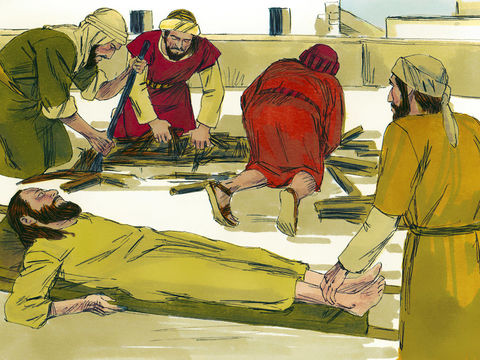
So it was that one day as Jesus was teaching, the power of the Lord was present for all to be healed, and there were Pharisees and teachers of the law from every town of Galilee, Judea, and Jerusalem. Certain ones brought a paralytic to be healed. This man was confined to his bed. Finding the crowd to be so huge they could not even get close to the door they removed a section of the roof and ceiling to let the man down right where Jesus stood. When Jesus saw what they had done, He was amazed at their faith, and told the man his sins were forgiven. Then the scribes and Pharisees began to reason in their hearts that “no one but God had the authority to forgive sins. So, they began thinking, “Who is this who utters such blasphemies?” (Luke 5:21). Jesus seeing them reasoning these things among themselves mentioned it to them. He asked them which would be easier, to tell a man his sins were forgiven or to tell him to pick up his bed and walk. Then He said to them:
“‘But that you may know that the Son of Man has power on earth to forgive sins’–He said to the man who was paralyzed, “I say to you, arise, take up your bed, and go to your house!'” (Luke 5:4).
When the man immediately arose, picked up his bed, and went home glorifying God, all present were amazed. They glorified God and were filled with fear at the strange and amazing things they had seen.
In an earlier lesson, I mentioned the veil which was rent into two pieces at the instant Jesus died on the cross. I noted this instant is when the New Covenant began. Prior to this time, the Old Covenant was still in effect. I would like to note that today’s lesson refers to the ‘kingdom of God’ several times. Each time it is referenced, it notes Jesus came to earth to preach the ‘kingdom of God.’ Jesus is still doing much of His teaching in the synagogues on the Sabbath. He is still preaching and teaching under the Old Covenant of the Jewish dispensation. He is preaching about ‘the kingdom of God’ , but it has not yet become a reality. That will happen when the veil is rent into two pieces. After that time, ‘the kingdom of God’ will be referenced in the present tense.
~~~~~~~~~~
- Lesson One: Zacharias to Have Son
- Lesson Two: Jesus Birth Foretold
- Lesson Three: Zacharias’ Son, John, is Born
- Lesson Four: Jesus is Born
- Lesson Five: And Jesus Grew . . .
- Lesson Six: John Begins His Ministry
- Lesson Seven: Jesus is Introduced to the World
- Lesson Eight: Jesus’ Ancestral Lineage
- Lesson Nine: Jesus is Tempted by Satan
- Lesson Ten: Jesus Begins His Ministry (Part 1)
- Lesson Eleven: Jesus Begins His Ministry (Part 2) — Sermon on the Mount (Part 1)
- Lesson Twelve: Jesus Begins His Ministry (Part 3) — Sermon on the Mount (Part 2)
- Lesson Thirteen: Jesus Begins His Ministry (Part 4) — Sermon on the Mount (Part 3)
- Lesson Fourteen: Jesus Begins His Ministry (Part 5) — Sermon on the Mount (Part 4 — Conclusion)
- Lesson Fifteen: Jesus Turns Water to Wine — The Wedding at Cana
- Lesson Sixteen: Jesus Heals the Sick, Casts Out Demons
~~~~~~~~~~
Picture Above: @ freebibleimages.org
~~~~~~~~~~









 by tkbrown
You must be logged in to post a comment.